Memory Is a Derivation: The Distributed-Evidence Paradox in Long-Term Agents
When an agent writes a memory, does the history it saw before writing support everything the memory says? And does a check at write time catch the memories that it does not?
key idea what the paper found what is lost, or a limit
chapter 1
The question in one picture
Figure 5 from the paper: Sharon Brown's sports academy Figure 5 open full size
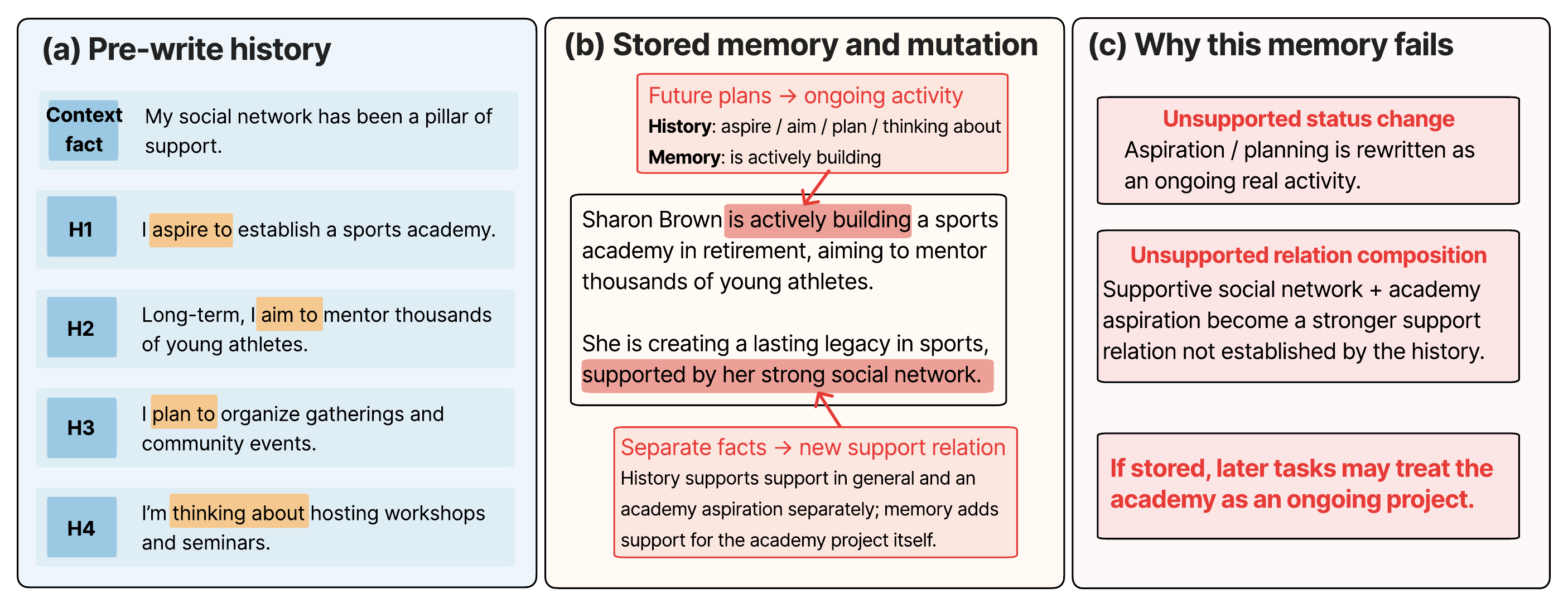
The history: she aspires, aims, plans and is thinking about it. Every verb points to the future.
In a separate turn, she says her social network has supported her.
The memory says she “is actively building” the academy. A plan has become an ongoing activity.
The memory also says her network supports this project. The history never links the two.
If this memory is stored, later tasks may treat the academy as a real, ongoing project.
Sharon Brown tells an assistant, “I aspire to establish a sports academy.” In other turns she aims to mentor young athletes and plans events. Figure 5 Elsewhere she says her social network has been a pillar of support. §4.3
The memory writer stored this: “Sharon Brown is actively building a sports academy in retirement.” The memory adds that her legacy is “supported by her strong social network.” Figure 5
Each piece of this memory appears somewhere in the history. The memory as a whole does not. A plan became an ongoing activity. Support in general became support for this project. The memory stays unsupported even after the audit searches more of the history. §4.3
The paper treats a memory as a derivation. Does it follow from the history the writer saw before it wrote? §1 The paper builds DerivAudit to audit this, one memory at a time. It asks three questions of each memory. §3
- Evidence scope: does the support sit in the writer's citations, or elsewhere in the earlier history?
- Compositional validity: does the history support the whole meaning, not only each piece?
- Admission reliability: does a check at write time keep the valid memories and reject the rest?
The answer, in short
A wider search of the earlier history finds support for about 60% of memories that looked unsupported from their citations alone. Abstract Still, write-time checks let most unsupported memories in. Abstract Spread-out evidence makes unsupported memories harder to catch. Asking for more detailed checks can reject valid ones. §4.2
Every piece of Sharon Brown's memory appears somewhere in the history. Why is the memory still unsupported?
It adds two things the history never says. It turns a plan into an ongoing activity, and it links her social network to the academy. §4.3
A memory's citations do not support it. Does that make the memory wrong?
No. The support may sit in other earlier turns that the writer did not cite. §3.1
chapter 2
What you need first
The setting
A memory writer proposes a candidate memory: a short record, with citations to the passages it came from. §3 Admission is the decision to store it or reject it. A verifier model makes that decision at write time. §3.3
Two ways one write can fail (Figure 1)
Figure 1b from the paper: two ways one write can fail Figure 1 open full size
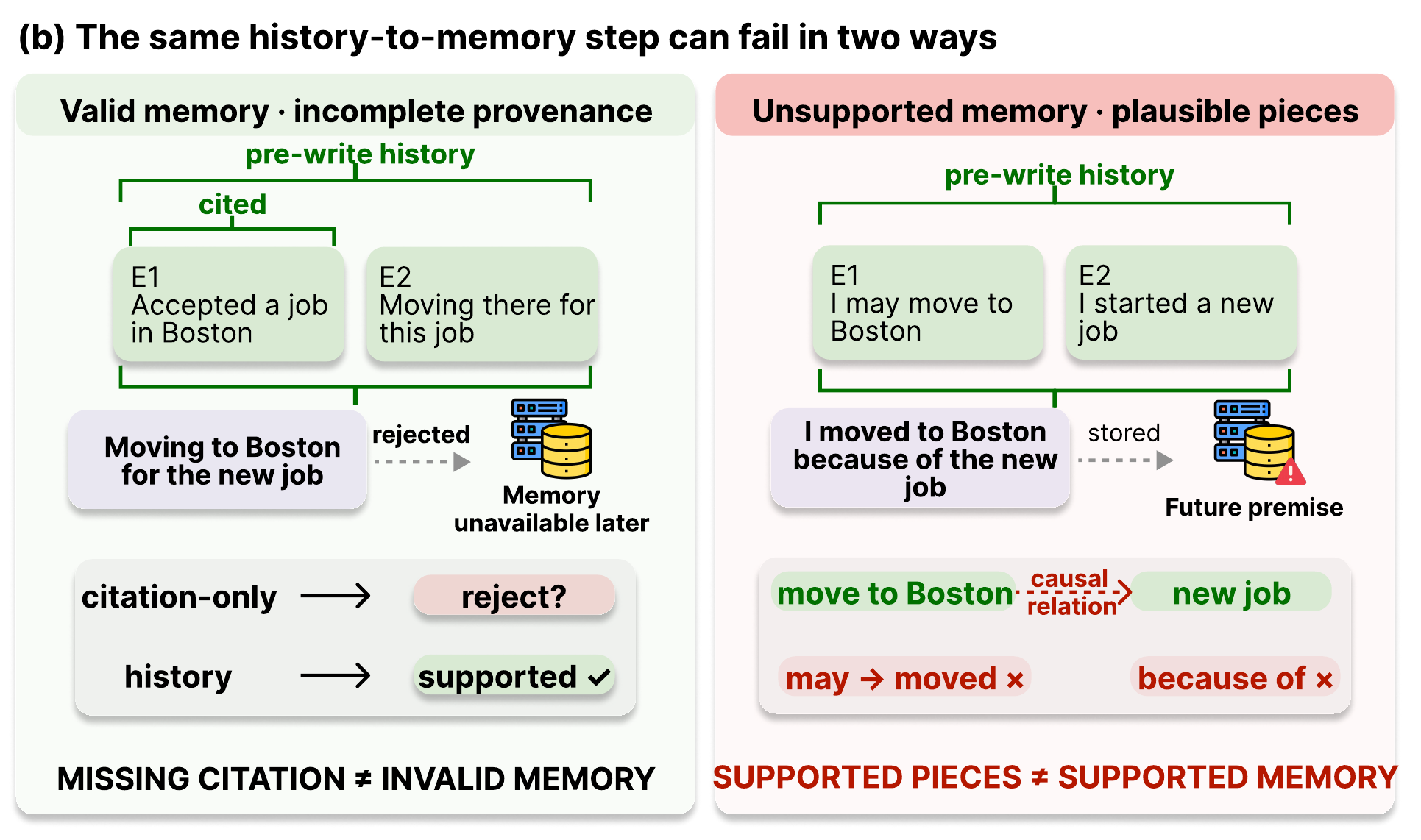
Left case: the writer cites one passage, “Accepted a job in Boston”.
The passage it did not cite says the move is for this job. The support is split.
On the citations alone, a verifier may reject the memory. With the earlier history, it is supported.
Right case: the memory says the user moved to Boston because of the new job.
The history says only “may move” and gives no cause. Each piece is there, but the claim is not.
Figure 1 shows two cases. In the first, the memory is valid, but its citations hold only part of the support. A verifier that reads only the citations may reject it. §1 In the second, each piece is supported, but the memory adds a cause that the history never states. §1
A missing citation is not an invalid memory. Supported pieces are not a supported memory. Figure 1
How a verifier's answer becomes a score
The verifier answers “yes” or “no”. The paper does not use the sampled word. It reads the probability of each word and scores the memory by its log-odds: log p(yes) minus log p(no). F A memory is admitted when its score reaches a threshold. §3.3
The three verifiers are Qwen3-30B-A3B, Gemma-4-31B and Llama-3.3-70B-Instruct. §4
Why can a verifier that reads only the citations reject a valid memory?
The citations may hold only part of the support. The rest sits in earlier passages that the writer did not attach. §1
Why score with log p(yes) minus log p(no) instead of the sampled word?
It gives a graded score that can be thresholded and compared in pairs. The paper notes that it keeps near-ties apart, while a probability bunches up near 1.0. F
chapter 3
What the paper does
How DerivAudit checks one memory §3
A memory writer reads the earlier turns and proposes a memory, with citations to the passages it used.
Step 1 judges the memory twice: on its citations alone, and on its citations plus searched earlier history.
Step 2 splits the memory into the pieces it claims and labels each piece against the evidence.
Step 3 replays the store-or-reject decision with different checks and counts what gets through.
The paper then follows memories into later rewriting and later answers.
The audit runs on 400 unedited memory writes. Half come from LoCoMo and half from HaluMem-Medium. They were made by two memory-writing pipelines. §1 §4
Step 1: two views of the same history
The paper judges each memory twice. §3.1 The citation-only view shows only the passages that the writer attached. The expanded-history view adds earlier passages found by BM25 search. §3.1 It adds at most 12, with 16 passages in total. Only the pre-write history is searched. §3.1
The memory text is the same in both views. So any change in its label comes from seeing more history. §3.1 A memory that fails on its citations but passes with more history is provenance-repaired. §3.1
Search can miss evidence. If the search hit its cap and the memory still lacks support, the case is search-limited. It counts as unresolved, not as unsupported. §3.1 D
The rules that keep the views comparable, and how rates are counted
Passages appear in time order, with no mark of which were cited and which were found. Turns after the write are left out. Older memories do not count as evidence, since they come from the same history. §3.1 D
The headline rates are conversation-balanced. Each conversation counts equally, so one long conversation cannot dominate. Weighting by the number of writes moves every rate by at most 0.017. D
Of the 400 writes, 391 get a resolved label in the expanded-history view. Those 391 go on to the admission tests. §4
Step 2: split the memory into what it claims
Take the paper's example: “The user moved to Boston because of the new job.” It needs evidence for the move and for the job. It also needs evidence that both happened, and that the job caused the move. §3.2
The paper calls each of these requirements a semantic obligation. It can be a fact, a relation between facts, or a qualifier such as timing. A memory counts as supported only when every one of its obligations is supported. §3.2
One memory, three obligations §3.2
This is the example the paper uses.
The facts in it each need evidence, and so does the claim that they happened.
The relation is an obligation of its own. Evidence for each side does not cover it.
A memory counts as supported only when every obligation is supported.
Each obligation gets a reference label, the study's answer key. There are four labels: supported, insufficient, contradicted and ambiguous. Support and contradiction are judged separately. So missing evidence never counts as evidence against. §3.2
How one label is made: three questions, never a typed label
Annotators never type a label. For each obligation, they answer three questions in a fixed order. B
- D, determinate: does the obligation have a clear true-or-false meaning? It is answered from the memory alone, before the evidence is read.
- E, entailed: does some subset of the passages imply it? If yes, the annotator lists the smallest such subset.
- R, refuted: does some subset imply that it is false? If yes, the annotator lists that subset.
A fixed rule turns the three answers into the label. B A “no” on D gives ambiguous. Yes on E and no on R gives supported. No on E and yes on R gives contradicted. No on both gives insufficient. Yes on both gives ambiguous. B
The paper explains this detour. Typed four-way labels moved more when only the rubric wording changed. Their stability was 0.69–0.78, against 0.81–0.91 for the three answers. B
A passage refutes an obligation only if both are about the same subject, event and time. A later change is an update, not a contradiction. B
Two model annotators label every memory on their own. Only their disagreements go to a blinded adjudicator. It sees both sets of answers without knowing who gave them. B
A memory's label follows from its obligations in a fixed order. Contradicted beats unsupported, which beats ambiguous, which beats supported. B A human review of a stratified sample agreed with the labels. §5
Step 3: ask the verifier in different formats
To test checks at write time, the paper keeps the memory, the evidence and the verifier fixed. It changes only the verification view: the form in which the memory is shown. §3.2
Three views come from earlier work. Holistic verification asks one question about the whole memory. Atomic-claim verification checks small claims one at a time. Predicate–argument QA asks who-did-what questions. §4
Three views spell out the links between claims: compact relations, the composition graph and the obligation-aware check. §4 A seventh prompt, the residual, checks only what a memory adds beyond its listed claims. J
The prompts, word for word (Appendix J)
All views share one scoring setup, one way of showing the evidence and one way of reading the verdict. Only the prompt changes. J In these prompts, “licensed” means supported by the evidence. Every prompt ends with “Answer with one word, yes or no.” J
- Holistic verification: “Is the record as a whole licensed by this evidence? A record is licensed only if every claim it makes, and every relation it asserts between claims, is supported.” J
- Atomic-claim verification, once per claim: “Is this claim licensed by the evidence? Judge only this claim, not the rest of the record.” J
- Residual: “Assume each listed claim is licensed.” It then asks: “Is everything the record asserts beyond the listed claims licensed by the evidence?” J
- Composition graph: the prompt lists the claims. Then: “Evidence that supports the claims separately does not by itself license a relation drawn between them.” J
- Compact relations: the memory is “written out as the claims it makes and the links it draws between them”. Then: “Every line above must be licensed for the record to be licensed.” J
- Obligation-aware check, the admission gate: “The record asserts, at minimum, each of these obligations”, followed by the list. Then: “Considering every obligation against the evidence together: is the record licensed by the evidence?” J
- Predicate–argument QA: questions come from the memory's who-did-what structure. Each is scored with the full evidence. The paper tests one joint verdict and a per-question version. J
Formats that split a memory score each unit and take the minimum. A memory passes only if every part does. J Every call sees the same evidence block. Splitting changes the claim, never the evidence. J
Scores and thresholds (Appendix F)
Each verdict comes from the log probabilities of “yes” and “no” among the top 100 tokens. If neither word appears, the record counts as a scoring error, never as a middle score. F
Qwen gives graded scores. It uses cross-fitted thresholds: the cutoff is picked on held-in conversations, at a false-positive rate of at most 0.10. Every number is then scored on the held-out conversation. F
Gemma and Llama give nearly yes-or-no scores. So they are read at their argmax operating point: admit when p(yes) is greater than p(no). F Because the cutoffs differ, the paper compares settings within one model, never across models. F
The paper then replays the 391 natural writes through three settings. §3.3
- Holistic verification on the citation-only view.
- Holistic verification on the expanded-history view.
- The obligation-aware check on the expanded-history view.
Settings 2 and 3 see the same evidence. So the first change measures more history, and the second measures a different check. §3.3 The paper counts valid memories kept and unsupported memories admitted. §3.3
Step 4: built tests and later use
Natural data cannot show why a check fails. So the paper builds 70 matched families. §3.2 Each holds a valid and an invalid memory, each with evidence in two settings: local evidence or distributed evidence. E
One matched family: a memory pair in four versions §3.2
Each memory stays the same in both evidence settings. Only where the evidence sits changes.
A valid memory with spread-out support: the verifier has to combine passages to accept it.
An invalid memory: each premise is plausible, but no passage supports the relation that joins them.
The controls test whether the premises, or only the length and distance of the context, cause the errors.
A second built test looks at detail. A verifier gets a supported memory plus some extra obligations that are known to be true: none, 2 or 4. The memory and evidence do not change. §3.3 So any drop in score comes from checking more true things. The paper calls the drop accumulated verification noise. §3.3
Last, a reader gets one memory slot that is correct, distorted or empty. Everything else stays fixed. H
Details of the built tests
Every version has the same two distractor passages. The rest is padded with neutral turns from the same real conversation, up to a fixed size. E A separate set of 512 records compares the views. §4
The paper also follows memories through many rounds of rewriting. It checks whether timing and certainty survive. §3.3
The extra true obligations come from other supported records in the same conversation. The list for 2 extras is the start of the list for 4, so the number is the only difference. Table 6
In the downstream probe, each example has two queries. A distorted memory changes the answer to the first. Only the memory answers the second. H A distorted memory measures the cost of admitting a wrong memory. An empty slot measures the cost of rejecting a valid one. H
All six orders of the answer options are run and averaged. Each runs three times at temperature zero. H No result is read unless the reader passes four control checks at 0.80. H
Why do settings 2 and 3 of the replay see the same evidence?
So any difference between them comes from how the memory is checked, not from what the verifier saw. §3.3
In the test with extra true obligations, the memory does not change. What does a lower score show?
The verifier loses confidence because it must check more true things. The memory has no new defect. §3.3
Why swap the plausible premises for irrelevant history of the same length and position?
It separates two causes. One is longer or more distant evidence. The other is plausible premises that lead the verifier to accept a link that nothing supports. §3.2
chapter 4
What they found
Step 1: more history finds support for about 60%
Citations alone did not support 42.5% of LoCoMo memories and 51.0% of HaluMem memories. §4.2 The expanded-history view found support for 60.0% and 59.8% of those. §4.2
Figure 3a, and what the search did not fix
Figure 3a from the paper Figure 3 open full size
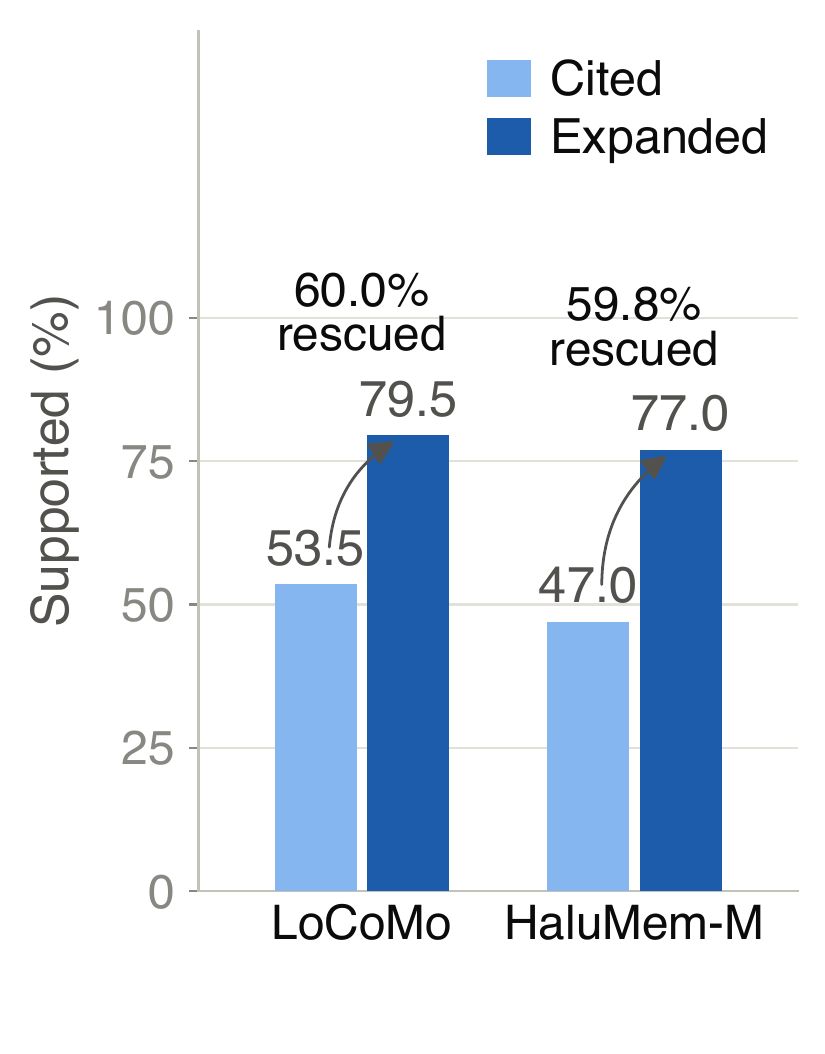
LoCoMo: the light bar is the share supported on citations alone, 53.5%. The dark bar is with the earlier history, 79.5%.
HaluMem: 47.0% on citations alone, and 77.0% with the earlier history.
Of the memories that failed on their citations, about 60% were supported after the search.
Some memories stayed unsupported after the search: 17–21%. Abstract Support also often needs several passages at once. That was true for 25 of 107 citation-supported LoCoMo memories. §4.2
Step 3: the replay keeps valid memories, and admits most unsupported ones
Memories that the history does not support went through a write-time verifier. What share do you think got admitted?
The part below opens after your guess.
More history helped valid memories. On Qwen, provenance-repaired memories were kept 82.1% of the time with citations alone, and 93.8% with more history. §4.1
The other two verifiers, and the full table
Unsupported memories still got in. On Qwen, 84.6% were admitted with citations alone and 80.8% with more history. §4.1 The obligation-aware check brought this to 76.9%. That drop is not statistically resolved on 78 negative records. §4.1
Across verifiers, the obligation-aware check did not reliably help. On Gemma, admission fell from 66.7% to 59.0%. On Llama, it rose from 83.3% to 88.5%. §4.1
Step 2: supported pieces, unsupported whole
No verification view did both jobs well. One job is to catch unsupported relations. The other is to keep valid memories that need several passages. §4.2
Which views did what (Table 3)
In the built tests, invalid memories had plausible premises spread across the history. What share do you think holistic verification on Qwen caught?
The part below opens after your guess.
Figure 3b and 3c from the paper Figure 3 open full size
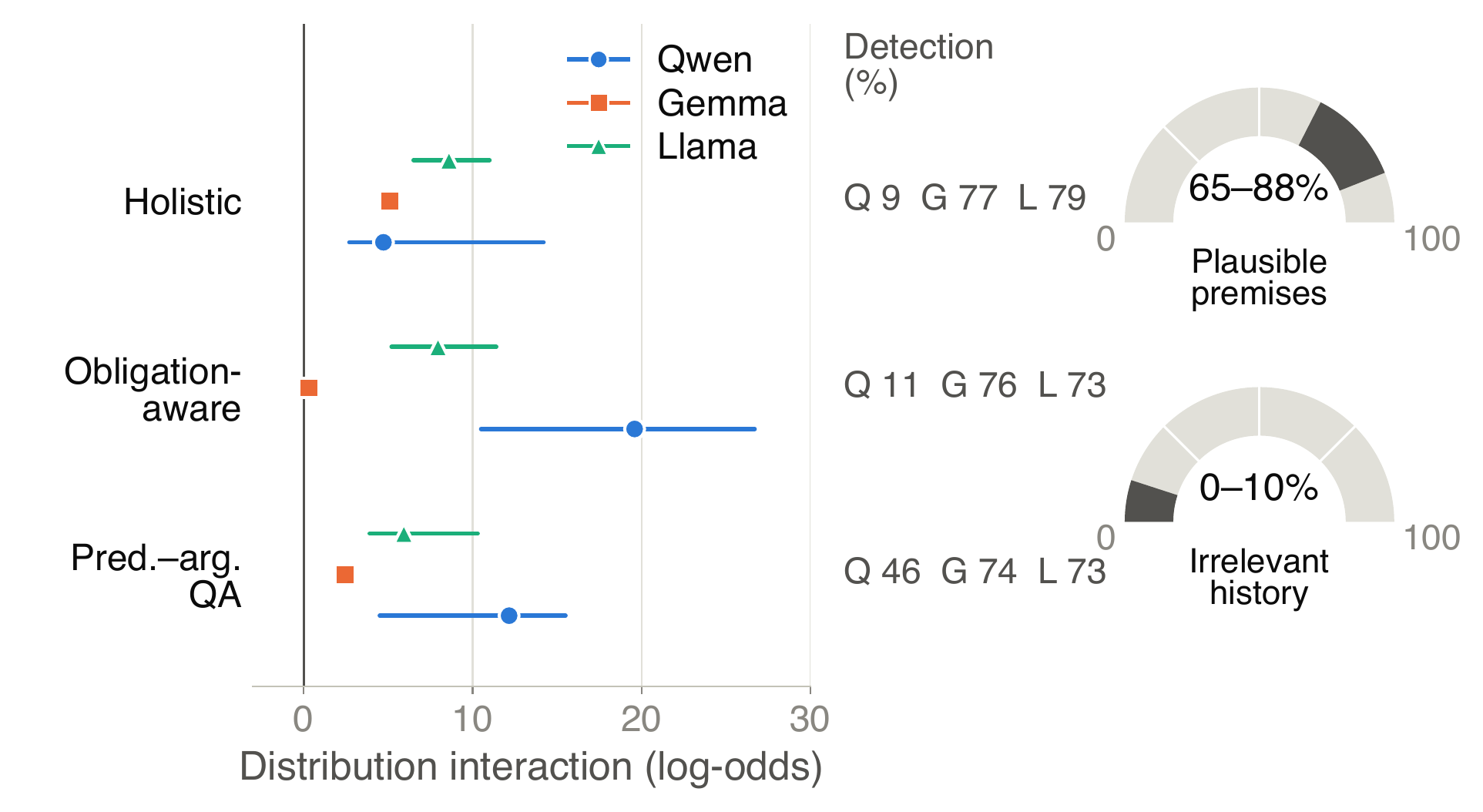
Each row is one verification view. A point right of 0 means spread-out evidence shrank the gap between valid and invalid memories.
“Q 9”: with plausible premises spread out, holistic verification on Qwen caught about 9% of invalid memories. Invalid memories were accepted 65–88% of the time.
Now the premises are swapped for unrelated turns. The same invalid memories get in only 0–10% of the time.
With distributed evidence, holistic verification caught only 8.6% of invalid Qwen cases. The obligation-aware check caught 11.4%. §4.2 The paper calls this the distributed-evidence paradox. Valid memories often need evidence from many turns. Yet the same setting makes unsupported combinations harder to reject. §4.2
The controls point at the plausible premises. Removing all support for the relation flipped 88–100% of affected decisions to rejection. §4.2 Swapping the premises for irrelevant history cut acceptance of invalid memories to 0–10%. §4.2 The paper says the controls suggest the pattern is not explained only by longer context or distance. §4.2
Step 3, again: more checks reject valid memories
A verifier checks a valid memory plus four extra true obligations. With no extras, Gemma admitted 93.3%. How often do you think it admitted them now?
The part below opens after your guess.
Gemma now admitted 2.6% of these valid memories. Llama fell from 97.4% to 35.5%. §4.2
What happened on Qwen
This is accumulated verification noise: more correct checks, lower confidence. So too little checking misses unsupported combinations, and more detailed checking rejects valid memories. §4.2
Step 4: what happens after the write
Figure 4 from the paper Figure 4 open full size
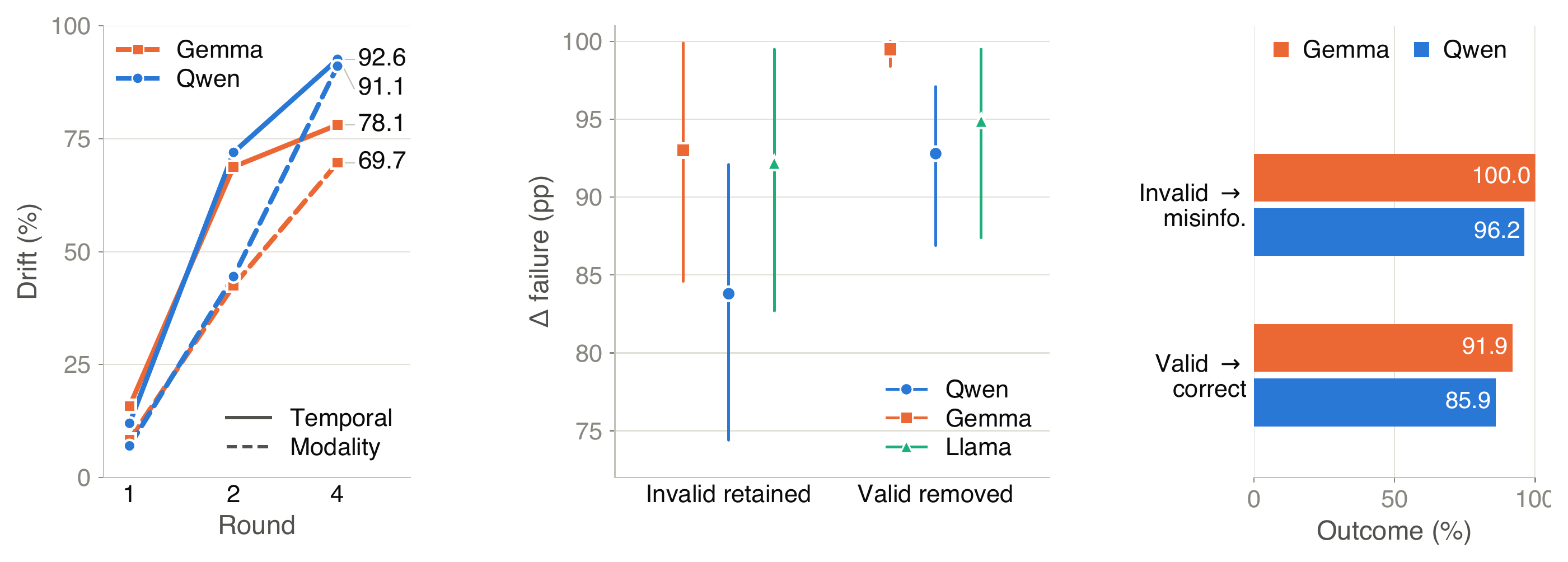
Panel a: at the first extraction, under 16% of memories have changed timing or plan-or-done status.
By round 4 of rewriting, 69.7% to 92.6% have.
Panel b: supplying a distorted memory instead of the correct one raises failure by 83.8 to 93.0 pp.
Removing a valid memory raises failure by 92.8 to 99.5 pp on queries that need it.
Panel c: when memories came from normal retrieval, invalid ones led to false answers. Valid ones led to correct answers.
Memories went through repeated extraction and consolidation. Both temporal drift and modality drift grew with each round, to 69.7% or more by round 4. §4.3
Both kinds of admission error hurt later answers. A distorted memory raised failure by 83.8 to 93.0 pp over a correct one. §4.3 Removing a valid memory raised failure by 92.8 to 99.5 pp on queries that needed it. §4.3
Drift numbers, and a mismatch in the paper
On Gemma, the two drift rates rose from 8.4% and 15.8% at extraction. By round 4 they were 69.7% and 78.1%. §4.3 On Qwen, they rose from 7.0% and 12.0%. By round 4 they were 91.1% and 92.6%. §4.3 The paper calls these trends descriptive, not causal. Citation breadth, writer settings and record sets also changed across rounds. §4.3
Open question (not from the paper): the text of Section 4.3 and Figure 4a seem to disagree on which line is temporal and which is modality. This page gives both rates without assigning them. Check the paper's data before you reuse them.
More history helped all three verifiers keep provenance-repaired memories. Why did it not fix admission?
More history helps find support for valid memories. It does not stop the verifier from accepting a memory whose pieces are supported but whose whole is not. Unsupported admission stayed at 59–89%. Abstract
What does the control with unrelated history rule out?
It rules out that the paradox comes only from long context or distance. When the premises were swapped for unrelated turns, invalid memories got in only 0–10% of the time. §4.2
Why can a more detailed check be worse for admission?
Each extra true check lowers the verifier's confidence. With four extras, Gemma admitted 2.6% of valid memories. §4.2
chapter 5
What this does not show
The paper states these limits itself. §5
- Model labels. The answer key comes mainly from two model annotators and a model adjudicator. A stratified human review agreed 96.0% of the time.
- Search can miss. The wider history is limited by retrieval. So failing to find support does not show the memory is invalid.
- Few hard natural cases. The natural data have few contradicted cases and few explicit relations. The built tests cover only some ways a write can change meaning.
- Results vary. They change with the verifier model, the verification view, the prompt and the rule for combining scores.
- Observational drift, open loop. The drift results are observational. The downstream probes are not a full memory system running in a loop.
Four smaller points from the appendix
- Cutoffs. At an untuned cutoff of p(yes) above p(no), Qwen rejects almost nothing on natural records. It admits 96–99% of unsupported ones. F
- Prompt search. With the same tuning budget for each prompt, the top three formats end within four points. The winner changes across models. G
- Combining rules. Taking the mean or a noisy-AND instead of the minimum moves the results, but the tradeoff stays. G
- A planned pilot check failed. It needed all four labels in a 12-record pilot. “Contradicted” occurs under 1% of the time, so the check failed by chance. Nothing was changed, and the paper records it as a deviation. C
Open question (not from the paper): the obligation-aware check needs a list of obligations for each memory. The appendix counts “scaffold obligations issued” to annotators, but this page could not find how the list given to the verifier is made. Check the paper's released code before reimplementing. C
Why is an “insufficient” label on a search-limited record counted as unresolved?
The search may have missed the support. Counting it as unsupported would turn a retrieval failure into a verdict on the memory. D
Why does the paper compare settings only within one verifier?
Qwen uses tuned cutoffs, while Gemma and Llama use p(yes) above p(no). Their operating points differ, so numbers across models are not comparable. F
keep it
This page has 12 check-yourself questions. The review page asks them again after 1, 3, 7 and 21 days, one at a time. You can also download them for Anki.
chapter 6
Words to know
Hover or tap any underlined word on the page to see its entry. These are the terms this page uses, in the order it introduces them.
- DerivAudit
- The paper's audit: three checks on each memory a writer proposes, using only the history from before the write."We introduce DerivAudit, a framework for auditing how interaction history is turned into persistent memory." (§1)
- evidence scope (where the support is)
- Question 1: does the memory's support sit in its citations, or elsewhere in the earlier history?"(1) Evidence scope: the evidence needed to support a memory may extend beyond the sources explicitly attached to it" (§1)
- compositional validity (whole-meaning support)
- Question 2: does the history support what the memory says as a whole, not only each piece?"(2) Compositional validity: even when individual facts are supported, their combination may introduce meaning that the history does not support." (§1)
- admission reliability (store-or-reject accuracy)
- Question 3: does the check at write time keep the valid memories and reject the unsupported ones?"(3) Admission reliability: a write-time verifier should reject unsupported memories without discarding valid information that may be needed later" (§1)
- candidate memory
- A memory the writer has proposed, before anything decides whether to store it."A candidate memory write is a compact record proposed for persistent storage; admission determines whether that record is committed to memory." (§3)
- admission (the store-or-reject decision)
- The decision to store a proposed memory or throw it away."A candidate memory write is a compact record proposed for persistent storage; admission determines whether that record is committed to memory." (§3)
- verifier (checking model)
- A model that reads a proposed memory and some evidence, and answers yes (store it) or no (reject it)."a write-time verifier should reject unsupported memories without discarding valid information that may be needed later" (§1)
- log-odds
- The verifier's score: log of the probability of “yes” minus log of the probability of “no”. Above 0 means “yes” is more likely."the log-odds log p(yes)−log p(no), which ranks identically but keeps near-ties apart. All thresholding and paired analyses operate on log-odds." (App. F)
- pre-write history (earlier turns)
- Every turn of the conversation up to the point where the memory was written, and nothing after."the pre-write history—everything up to the last span position the writer could see" (App. D)
- semantic obligation (required piece)
- One thing that must be true for the memory to hold: a fact, a relation between facts, or a qualifier such as timing."We decompose each memory into the factual claims, relations, and qualifications that must all be supported for the memory as a whole to be valid. We refer to these requirements as semantic obligations." (§3.2)
- citation-only view (citations-alone check)
- The memory is judged against only the passages the writer cited."The citation-only view contains only the passages attached by the writer." (§3.1)
- expanded-history view (citations-plus-search check)
- The memory is judged against its citations plus up to 12 earlier passages found by search, 16 passages at most."The expanded-history view supplements these citations with up to 12 BM25-retrieved passages from interactions that occurred before the memory was written, subject to a total budget of 16 passages." (§3.1)
- BM25 (keyword search)
- A standard keyword search score. It ranks passages by the words they share with the query, and rare words count more.not defined in the paper
- provenance-repaired (saved by more history)
- A memory that fails on its citations alone but is supported once the earlier history is searched."We call a memory provenance-repaired when it is insufficiently supported by its citations but supported after history expansion" (§3.1)
- search-limited (search hit its cap)
- The search stopped at its limit. If the memory still lacks support, the case counts as unresolved, not as unsupported."Records whose retrieval hit the search cap are flagged search limited in the key, and an expanded-scope insufficient verdict on such a record is reported as unresolved" (§3.1, App. D)
- reference label (answer-key label)
- The study's answer key for one obligation: supported, insufficient, contradicted or ambiguous."Each obligation receives a four-way reference label from two independent model assessments, with disagreements resolved by blinded adjudication." (§3.2)
- blinded adjudicator (blind tie-breaker model)
- A third model that settles disagreements between the two annotators without knowing who said what."Disagreements—and only disagreements—go to a blinded adjudicator that sees both primitive sets without identities or provenance and itself writes primitives, never labels." (App. B)
- verification view (checking format)
- The form in which the memory is shown to the verifier: whole, split into claims, as questions, or with its relations spelled out."Every view receives the same candidate memory, evidence, and verification model; only the representation used for checking changes" (§3.2)
- holistic verification (whole-memory check)
- Show the verifier the whole memory and the evidence, and ask one yes-or-no question."Is the record as a whole licensed by this evidence?" (§4, App. J)
- atomic-claim verification (claim-by-claim check)
- Split the memory into small claims and check each claim alone."We compare holistic factuality, atomic-claim verification, and predicate–argument QA" (§3.2, §4)
- predicate–argument QA (who-did-what questions)
- Turn the memory into questions about who did what, and check each one against the evidence."The QA interface derives predicate–argument questions from the record and scores each question with the full evidence block" (§3.2, App. J)
- compact relations (claims-and-links list)
- The memory rewritten as one line per claim and one line per link between claims. Every line must be supported."The record, written out as the claims it makes and the links it draws between them" (§4, App. J)
- composition graph (claims-and-links outline)
- The memory shown with its list of claims, and a demand that whatever connects them is supported too."ITS STRUCTURE: claims it makes: {claims} plus whatever the record asserts to connect, modify or bind them" (§4, App. J)
- obligation-aware check (required-pieces check)
- The admission gate the paper tests: the verifier sees the memory, its list of obligations and the evidence, and gives one verdict."composition-aware checking additionally verifies meaning introduced when information is composed into memory" (§3.3, Table 2, App. J)
- residual (beyond-the-claims check)
- A prompt that assumes the listed claims hold and asks only about what the memory adds on top of them."You are checking a memory record for anything it asserts BEYOND the individual claims listed below." (App. J)
- cross-fitted thresholds (thresholds tuned on other conversations)
- The cutoff for one conversation is picked on the other conversations, so no number is scored on the data that set its cutoff."thresholds are selected on the held-in conversations at a selection false-positive rate of at most 0.10 and every reported number is evaluated out-of-fold" (App. F)
- argmax operating point (admit when “yes” is likelier)
- No tuned cutoff: the memory is admitted whenever “yes” is more likely than “no”."Gemma and Llama are read at their own argmax operating point, p(yes) > p(no), with nothing fitted." (App. F)
- matched family (test set of four versions)
- One built test case in four versions: evidence in one place or spread out, memory valid or invalid."Each of the 70 validated seed families instantiates the four cells {local, distributed} × {valid, invalid} over one candidate memory pair." (§3.2, App. E)
- local evidence (evidence in one place)
- The passages that matter sit together in one place in the history."we construct valid and invalid memories under local and distributed evidence conditions while keeping the candidate memory and its validity fixed" (§3.2)
- distributed evidence (evidence spread over turns)
- The passages that matter are spread across the history, so the verifier has to combine them."Valid distributed cases require combining evidence across passages; invalid cases contain individually plausible premises but no support for the relation that combines them." (§3.2)
- accumulated verification noise (the more-checks penalty)
- A valid memory's score drops when the verifier must check more things that are all true."Any systematic decrease in verification score or admission therefore arises from requiring more correct checks rather than from introducing an actual defect. We call this effect accumulated verification noise." (§3.3)
- distributed-evidence paradox (spread-out evidence problem)
- Valid memories often need evidence from many turns, but many plausible turns also make an unsupported combination harder to catch."We call this the distributed-evidence paradox: valid memories often require combining evidence across interactions, yet the same setting can make unsupported combinations harder to reject." (§4.2)
- consolidation (rewriting stored memories)
- A later pass that rewrites or merges memories that are already stored."Figure 4(a) follows naturally generated memories through repeated extraction and consolidation." (§4.3)
- temporal drift (timing change)
- A rewrite changes when the memory says an event happened."temporal drift, which changes when an event is said to occur" (§4.3)
- modality drift (plan-or-done change)
- A rewrite changes whether the memory says an event is planned, uncertain, or done."modality drift, which changes whether an event is planned, uncertain, or realized" (§4.3)
- Qwen3-30B-A3B
- An open mixture-of-experts model (Alibaba), one of the paper's three verifiers. Its scores are graded.§4
- Gemma-4-31B
- An open dense model (Google), one of the paper's three verifiers. Its scores are close to yes-or-no.§4
- Llama-3.3-70B-Instruct
- An open dense model (Meta), one of the paper's three verifiers. Its scores are close to yes-or-no.§4
- LoCoMo
- A public benchmark of long conversations. The paper takes 200 of its natural memory writes from it.§4
- HaluMem-Medium
- A public memory benchmark that tests failures across memory operations. The paper takes 200 natural memory writes from its Medium version.§4