Language Model Memory Flattens the Temporal Form of User Facts
When a model saves a note about a user, does it keep the verb that meant “for now”? And does the model that reads the note later use it?
key idea what the paper found what is lost, or a limit
chapter 1
The question in one picture
What happens to one sentence
Act now, or ask the user first?
A user tells a chat assistant something about their life.
A model reads the chat and saves a short note for later.
The note keeps the person and the company. The “-ing” verb, which can mean “for now”, is gone.
Months later, another model sees the note. It never sees the chat.
It has to decide if the fact still holds, and whether to check with the user before it acts.
A user tells a chat assistant, “I am working at Corvida.” A model reads the chat and saves a note: “The user works at Corvida.” §1
Both sentences name the same person and the same company. Something is still missing. “Am working” can mean the job is for now. “Works” reads like a settled fact. §1
The paper calls this loss aspectual flattening. The note keeps the fact but drops the cue that the fact may be temporary. Abstract
The model that writes the note is the memory writer. The model that reads it later is the reader model. The reader never sees the chat, so the note is the only message it gets. §1
The paper asks two separate questions. Does the writer keep the user's verb form? When the form survives, does the reader use it? §1
The answer, in short
A writer sometimes changed only the “‑ing” statement of a pair: “am working” became “works”. How often do you think it did the reverse, “work” to “is working”?
The part below opens after your guess.
Three writers each wrote notes for about 127 test pairs, 381 in all. In 210 pairs, the writer lost the “‑ing” verb and kept the plain one. The reverse never happened. §5
Readers noticed the verb when it survived. They did not all act on it the same way. §8
Both notes in the picture were true when written. What is lost, then?
The cue that the job might be temporary. “Am working” can mean “for now”, and “works” reads as a settled fact. The reader cannot ask the user what was meant.
Why does the paper test the writer and the reader separately?
If you only score what the reader finally does, you cannot tell which side lost the cue. The writer may drop it, or the reader may ignore it. §1
chapter 2
What you need first
1. A verb can show time
“I am working at Corvida” uses the progressive form. It presents the job as ongoing, and maybe temporary. “I work at Corvida” uses the simple-present form. It presents the job as a standing state. §3
Linguists call this property aspect. §1
These are cues, not rules. Context can make a progressive fact last for years. The paper's claim is narrow: when everything else is the same, a writer should not erase the difference. §3
2. A memory note is a message
A memory system saves facts from past chats as short notes for a later model. Abstract The paper treats each note as a message. The reader cannot ask the writer what was meant, so the note itself must carry the evidence. §1
Many memory systems also save a date. A date shows when the user spoke. It does not show whether the user presented the job as temporary. §1
3. Matched pairs, and why only some pairs count
To test the verb alone, you need two statements that differ only in the verb. The paper calls this a matched pair. §4.1
How a matched pair is scored
A matched pair differs only in the verb form. The words around it and the date are the same.
The same writer makes one note for each statement, on its own.
If both notes keep their form, or both change, the pair says nothing.
Only pairs where exactly one note changed carry evidence.
The paper's main result: 210 pairs of the first kind, and none of the second.
An exact McNemar test compares these two counts. It asks if one kind of change is more common than chance would predict. §4.4
A writer changes both notes in a pair. Does that pair count as evidence of flattening?
No. Both notes changed, so the change has nothing to do with the verb form. Only pairs where exactly one note changed count.
A note keeps the date but loses the progressive form. What can a reader still learn?
It can learn how old the fact is. It cannot learn that the user presented the fact as ongoing, and maybe temporary. §8
chapter 3
What the paper does
The paper builds LAPSE (Linguistic Aspect Persistence and Stability Evaluation), a test set of matched pairs. §1 Each pair is about one invented fact, such as a job at “Corvida”. The facts come in eight frames, such as workplace, vehicle and lodging. §4.1 Figure 2b
Every statement carries a date. In the main test, the note is read 245 days later. Neither form gets an extra time phrase such as “at the moment”. An automatic check rejects any pair that differs in more than the verb. §4.1
The write test
A model gets a short conversation and writes one note. A rule cascade then labels the note by its exact words. The main label is the aspect flip: the note's verb form no longer matches the user's. §4.3
The paper fixed three writers and their test before any data came in. It calls them the confirmatory writers: DeepSeek V4 Flash, GPT-5.6 Luna and GLM-5.2. §4.2 Each tested model, with its server and settings, is a model configuration. §4.2
Figure 1 from the paper §1 open full size
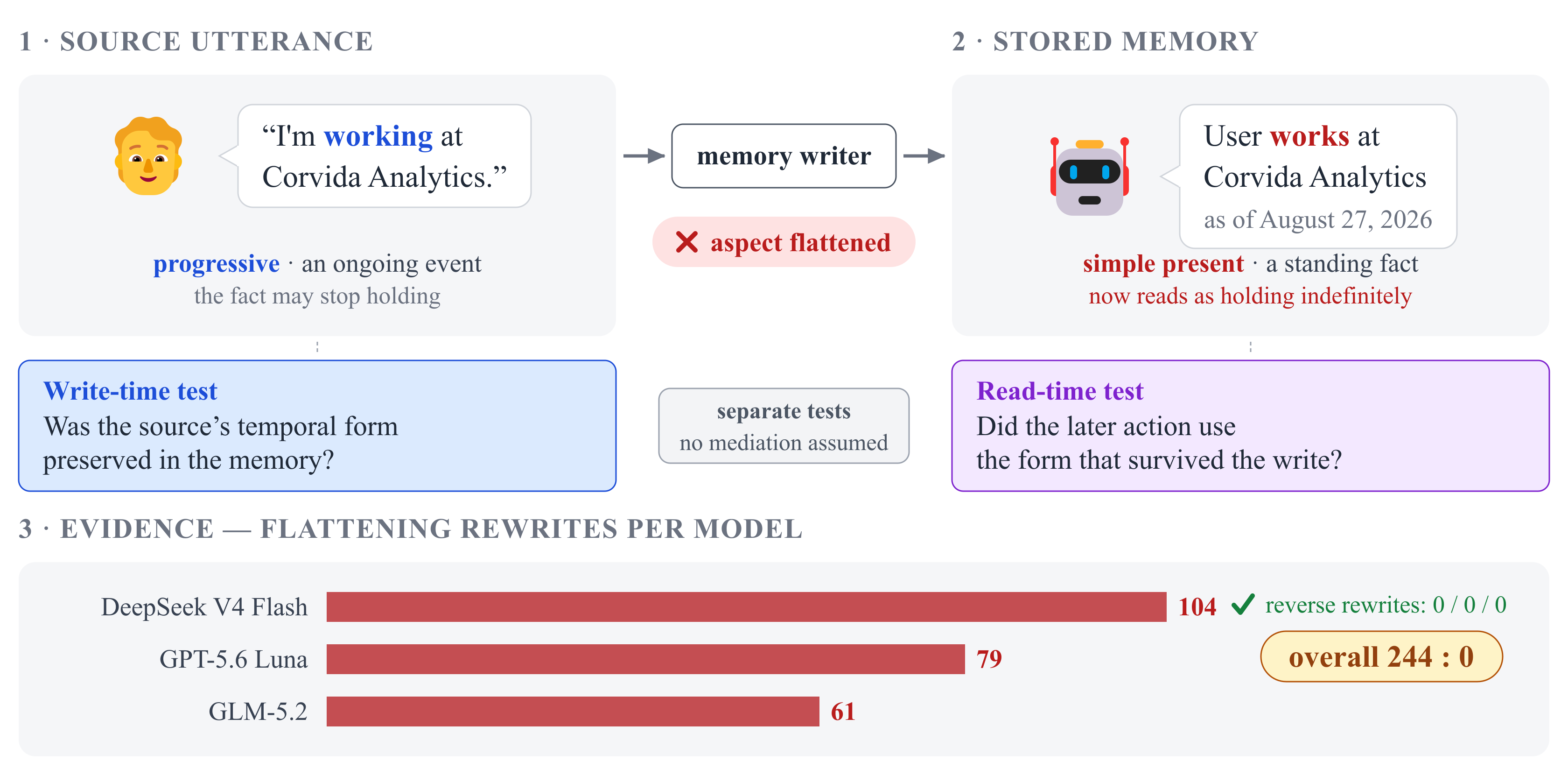
Panel 1: the user's statement, with the progressive verb “working”.
Panel 2: the note that the mem0 memory system really wrote. The verb is now simple-present: “works”.
The write test asks: did the note keep the user's verb form?
The read test asks: does a later model use the form that survived? The paper runs the two tests separately.
These bars add up to 244, the paper's planned count. It also counts 34 notes that only added “currently”. The main text leaves them out: 210 to 0. The 0 is the reverse.
The read tests
Most read tests in the paper are exploratory: they were not part of the plan fixed before the data. §7
In the dated-note task, a reader sees one note, the date it was written, and today's date eight months later. It gives a persistence estimate: a score from 0 to 100 for how likely the note is still true today. Then it fills in a field or writes UNKNOWN. §7.1
In the verification-tool task, a reader gets one dated note, a user request and two tools. One tool acts on the saved value. The other asks the user to confirm it first. This test was planned. §7 §7.4
Labels, controls, and a test that could not see anything
Two people also labeled 64 notes without knowing which form each note came from. The rules' label matched the first person on 60 notes and the second on 58. §4.3
Notes get one of five labels. A coerced-stative note turns an ongoing statement into a settled fact. A manufacture note adds “currently”, or a progressive verb with no date. §4.3
The plan counted both as an aspect flip. People in the human check did not read manufacture notes as losing the progressive form. So the main count leaves them out. The test passes either way. §1 §4.3
A control asked each model if an eight-month-old fact is still safe to assume. All but one model said “no” for nearly every statement, in either form. So these models do treat old facts as possibly out of date. §5
The first planned read test, the memory-use task, could not see any time evidence. Readers still used 59 to 60 of 60 facts whose stated end month had already passed. A test that ignores a passed end date cannot show a weaker cue. §7.1
Why do both statements in a pair get the same date?
So the date cannot explain a difference. Within a pair, only the verb changes. §4.1
Figure 1 shows 244 pairs, but the main text says 210. Why?
chapter 4
What they found
Writers lose the progressive, one way only
The one-way loss held in all 11 configurations: 722 pairs to none. §5 It also held in three released memory systems: mem0, Graphiti and Letta. §6
Figure 2a from the paper §5 open full size
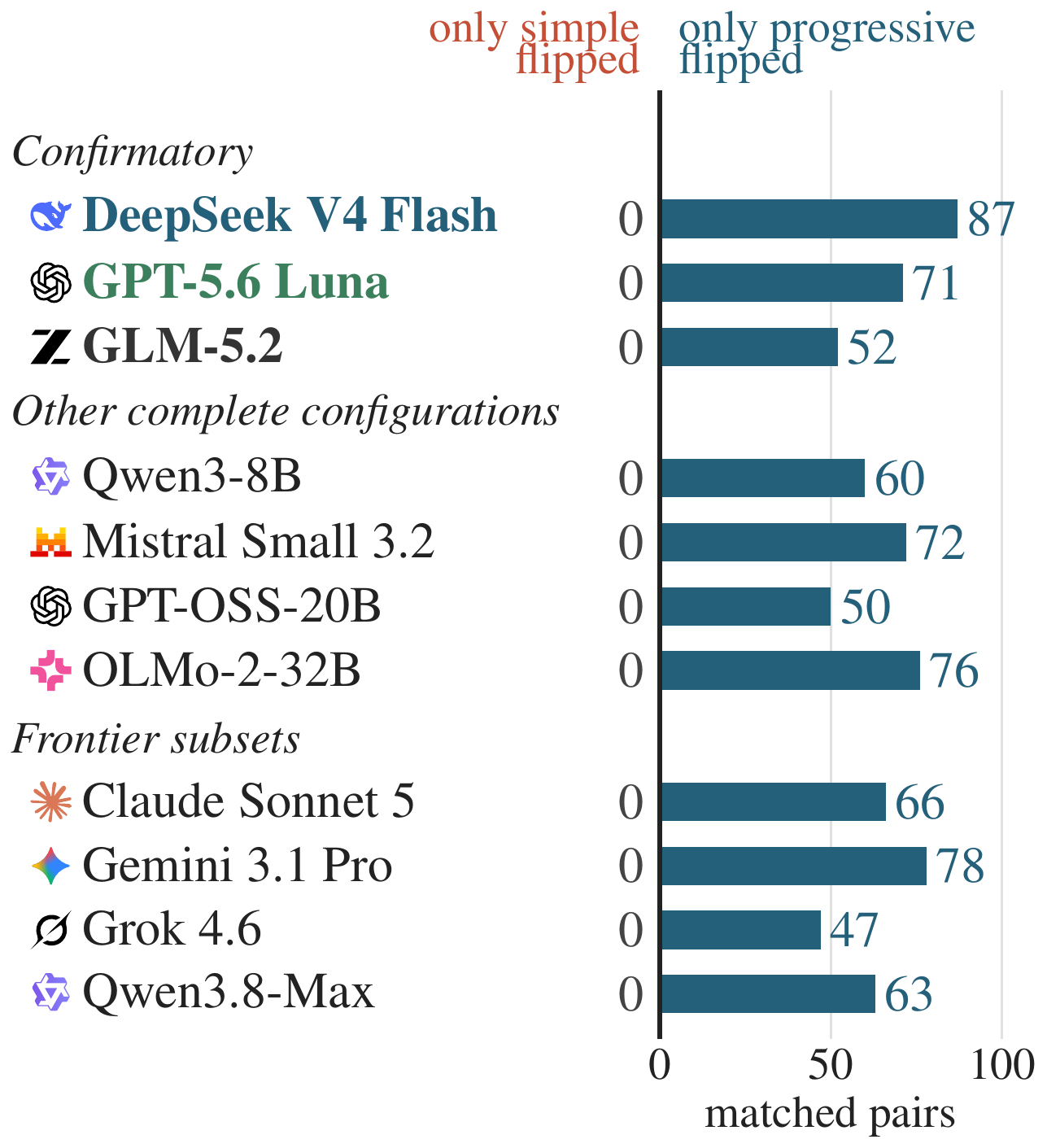
Each bar counts pairs where only the progressive note changed. Every one of the 11 models has a long bar.
This column counts pairs where only the simple-present note changed. It is 0 in every row.
How often depends on the fact and the writer
The rate depended on the frame and on the writer. §5.1
Which facts lose it most, in Figure 2b
All three writers often flattened vehicle and workplace facts, and rarely household and project facts. Which frames lost the most depended on the writer. DeepSeek V4 Flash flattened all 16 lodging statements, and GPT-5.6 Luna none. §5.1
Figure 2b from the paper §5.1 open full size
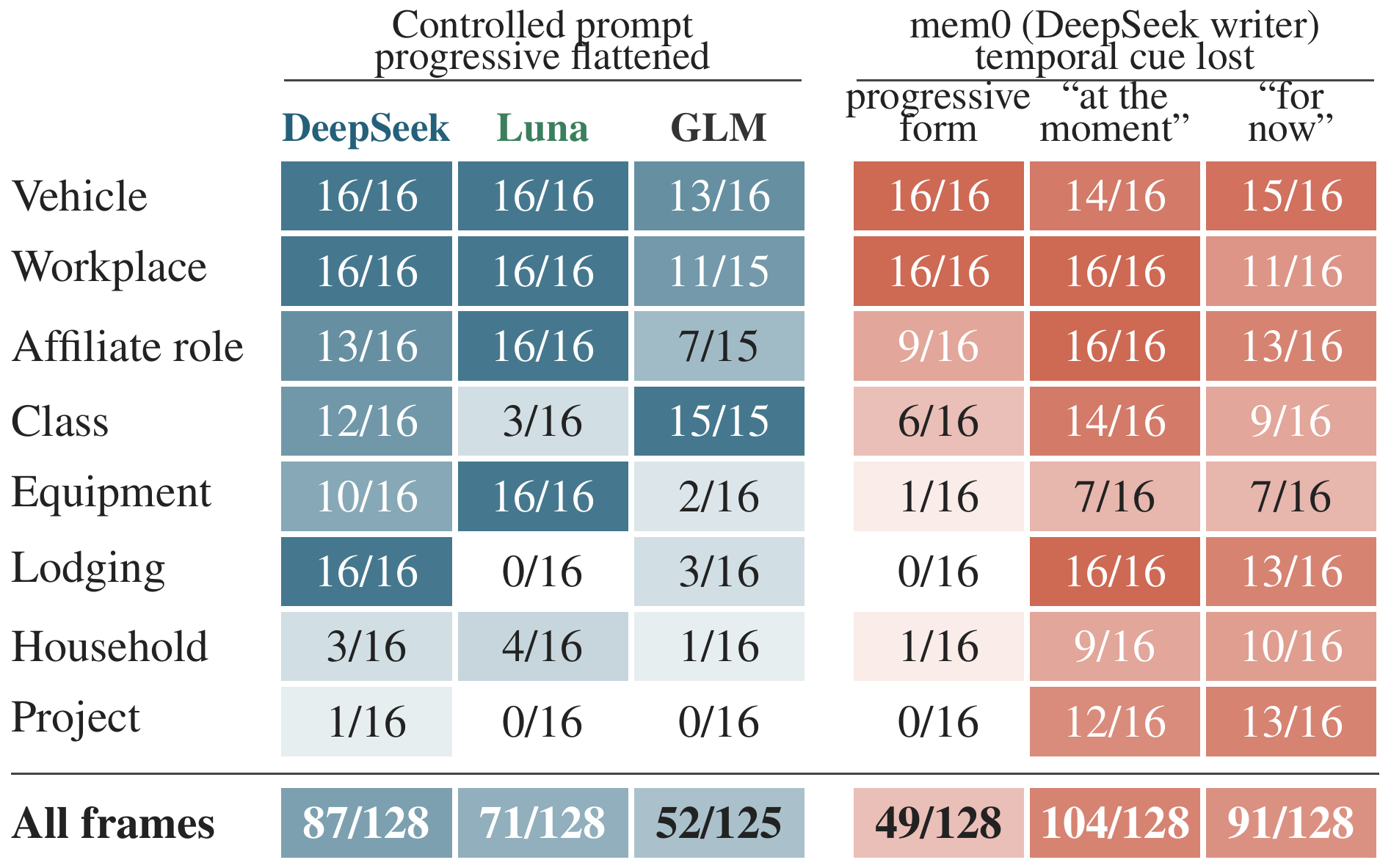
In the vehicle and workplace frames, statements lost the progressive form often, for all three writers.
In the household and project frames, they rarely did.
The writers also disagree: one flattened all 16 lodging statements, another none.
An instruction is not a reliable fix. Asking writers to keep tense and aspect removed flattening for GPT-5.6 Luna and partly helped DeepSeek V4 Flash. It made two other writers worse. §5.1
Readers notice the verb, but act on it differently
A reader rated from 0 to 100 how likely an eight-month-old note still holds. How many points lower do you think it rated the progressive note?
The part below opens after your guess.
Three readers took the dated-note task. Each gave the progressive note a persistence estimate 16 to 32 points below the matched simple-present note. §7.1
A test that changed only the verb
The paper took notes that mem0 wrote and turned “is working” into “works”, checking every edit by hand. Every reader then raised its persistence estimate. In this format, the stored verb itself changes how long a reader expects a fact to hold. §7.3
GLM-5.2 sees one dated note: “user works at Corvida” or “user is working at Corvida”. Which one do you think it acted on more often without asking?
The part below opens after your guess.
The verification-tool task, one reader §7.4
Two saved notes that differ only in the verb.
The reader sees one note and a user request. The note is eight months old.
It has two tools. One acts on the saved value. The other asks the user to confirm it first.
GLM-5.2 acted without asking on 187 of 291 “works” notes, and on 116 of 291 “is working” notes.
The verification-tool task asks a harder question: does the verb change what a reader does? For GLM-5.2, it did. It acted without asking on the simple-present note alone in 91 pairs. It did so on the progressive note alone in 19. §7.4
Other readers differed. Gemini 3 Flash showed a smaller gap in the same direction. Kimi K2.6, added after the main test, acted more often on the progressive note. Two readers asked first on every note a month or older, and one acted on every note. §7.4 So no single note wording suits every reader. §9
A note that keeps the user's words
A record is another kind of note. It has four parts: the user's words, a short fact, the verb form, and the date. §7.4
Free text or a record (made-up example values) §7.4
A free-text note, as a writer usually saves it.
The record keeps the user's own sentence in its first part. Every record kept it.
The other parts hold a short fact, the verb form, and the date.
Pairs where GLM-5.2 acted on only one note: simple-present side first, progressive side second. On free text the counts are close. On records they are far apart.
DeepSeek V4 Flash wrote each of 120 facts twice, once as free text and once as a record. In free text it flattened 99 of the 120 progressive statements. §7.4
So most of these new notes already said “works” before GLM-5.2 read them. Its gap on them was 23 : 19. The 91 : 19 above came from different notes that kept the verb.
On records, the gap came back: 113 : 18. Most of it came from the user's own sentence. This test is exploratory. §7.4 §8
Released systems, dates, and a field that misleads
The released systems lose the cue too. With DeepSeek V4 Flash as its writer, mem0 flattened 49 of 128 progressive statements. Graphiti flattened 47 of the 95 facts it stored. Letta flattened 62 of 90. §6
Dates and verbs carry different evidence. A date tells the reader how old a fact is. The verb tells it whether the user presented the fact as ongoing. §8
mem0 often adds a date such as “as of January 2026”. GLM-5.2 asked about nearly every dated mem0 note, in either form. Its difference between the forms came from the notes without a date. §7.4
Extra fields can mislead. Graphiti has an end-date field. When it was empty and shown as “valid until: not set”, every reader treated kept progressive facts as more likely to still hold. §7.2
Flattening also showed up in 104 real statements about users' lives, taken from public chat datasets. §5
GLM-5.2 saw two notes that differ only in the verb. On which one did it act without asking more often?
On the simple-present note, “user works at Corvida”: 187 of 291 times. On the progressive note it was 116 of 291. §7.4
chapter 5
What this does not show
The paper states these limits itself. §10
- Made-up English statements. All statements are synthetic and in English, with neutral wording. Real users signal “for now” in many other ways.
- Actions, not harm. The read tests count how often a reader acts without asking. They do not count how often that action went wrong.
- Mostly exploratory read tests. Most read tests were not planned before the data, so they were not tested predictions. Even the planned verification-tool task set the note age separately for each reader, so their gaps cannot be compared directly. Kimi K2.6 was added afterward.
- The cause is open. The study measures the loss. It does not test why it happens. Notes are usually written in the third-person simple-present. Rewriting every statement that way would give the same one-way loss. So the loss may come from a note-writing habit.
Three smaller limits
- No tests with people. The paper did not test how people read the two forms.
- One version per system. Each memory system ran in one version. So the paper shows that flattening happens in released systems, not how often it happens in real products.
- Server variation. Identical calls to a reasoning model varied by about five points of persistence estimate on the vendor's server, and about three times as much across other hosts. So a model's result may change with the server it runs on.
A note that keeps the user's words also keeps more personal detail. How should a memory system weigh that against what the reader needs?
The verification-tool task counts actions without asking. What else would you need to call those actions mistakes?
Whether the fact had changed by then. The paper counts actions. It does not count outcomes. §10
Name one reason the result might not hold for real users.
The statements are synthetic, English-only and neutrally worded. Real users mark “for now” in many other ways. §10
keep it
This page has 10 check-yourself questions. The review page asks them again after 1, 3, 7 and 21 days, one at a time. You can also download them for Anki.
chapter 6
Words to know
Hover or tap any underlined word on the page to see its entry. These are the terms this page uses, in the order it introduces them.
- aspectual flattening (rewriting “is working” as “works”)
- A note keeps the fact but loses the verb form that showed the fact might be temporary."A note can turn progressive “I am working at Corvida” into simple-present “The user works at Corvida,” dropping the cue that the job may be temporary. We call this aspectual flattening" (Abstract)
- memory writer (note-writing model)
- The model that reads a chat and saves a short note about the user."A memory writer, the model or pipeline step that turns a conversation into stored notes" (§1)
- reader model (note-reading model)
- The model that sees the saved note later, without the chat, and decides what to do with it."The model that later reads the note never sees the conversation, so the note is the only message it receives." (§1)
- progressive (“-ing”)
- The verb form with “be” plus “-ing”, as in “I am working at Corvida”. It presents something as going on now."Progressive form typically presents an event as ongoing." (§3)
- simple-present (plain-form)
- The plain verb form, as in “I work at Corvida”. It usually reads as a habit or a settled state."Simple present often supports a habitual or stative reading" (§3)
- aspect (the verb's time shape)
- Whether a verb shows something as still going on (“is working”) or as a settled state (“works”)."Aspect is how a sentence presents the internal temporal structure of a situation, for example as ongoing or as a standing state" (§1)
- memory system
- Software that saves facts about a user from past chats and shows them to a model in later chats."Long-term memory systems store conversations as short notes that later models read." (Abstract)
- matched pair
- Two user statements that are the same in every way except the verb form."The unit of analysis is a matched pair of user statements, each given to a model with the same memory-writing instruction. Within a pair, the topic, main verb, surrounding conversation (the carrier), and elapsed time are identical; only the temporal form changes." (§4.1)
- exact McNemar test (matched-pair count test)
- A test for matched pairs. It looks only at pairs where the two sides came out differently, and asks if one kind of difference happens more often than chance would predict."A one-sided exact McNemar test compares pairs in which only the progressive note flipped with pairs in which only the simple-present note flipped." (§4.4)
- LAPSE
- The paper's test set: pairs of user statements that differ only in the verb form."We build LAPSE (Linguistic Aspect Persistence and Stability Evaluation), a controlled benchmark of matched user statements" (§1)
- frame (kind of fact)
- What the fact is about: a workplace, a vehicle, a place to stay, a class, and so on. LAPSE has eight."the frame, the kind of fact a statement reports (for example, a workplace or a vehicle)" (§4.1)
- rule cascade (fixed word-matching rules)
- A list of fixed rules that labels each note by the exact words in it. It gives the same label every time."Memory-write outputs, which carry the main result, are labeled by a deterministic rule cascade that matches explicit surface cues." (§4.3)
- aspect flip (form change)
- The note's verb form no longer matches what the user said: “is working” became “works”, or “works” became “is working”."The main outcome is an aspect flip: a progressive source flips when its note is coerced-stative, which is flattening, and a simple-present source flips when its note adds a progressive." (§4.3)
- confirmatory writers (three writers chosen before the data)
- DeepSeek V4 Flash, GPT-5.6 Luna and GLM-5.2. The paper fixed these three writers and their test before it collected any data."The three confirmatory configurations were chosen before data collection; the other configurations test breadth and are not part of the confirmatory tests." (§4.2, §5)
- model configuration (model setup)
- One model together with the company serving it and its settings. The same model can answer differently on a different server."We call each tested system a model configuration because the serving provider and settings can change a model's outputs." (§4.2)
- exploratory (outside the main plan)
- A test that was not part of the main plan fixed before the data. Its result is weaker evidence than a planned test."Of two planned tests, the memory-use task was saturated, and the verification-tool task (Section 7.4) showed GLM-5.2 and Gemini 3 Flash acting without asking less often on progressive notes. The other tests are exploratory." (§7)
- dated-note task (one-note reading test)
- A test where a reader model sees one saved note and two dates, then scores the note and fills in a field or writes UNKNOWN."A reader sees one third-person memory note, its write date, and today's date eight months later." (§7.1)
- persistence estimate (still-true score)
- A number from 0 to 100 that a reader model gives for how likely the note is still true today."It first gives a persistence estimate from 0 to 100 for whether the note still holds" (§7.1)
- verification-tool task (act-or-ask test)
- A test where a reader model must either act on the saved fact or ask the user to confirm it first."The reader gets one dated note, a user request, and two tools. One tool completes the request with the remembered value, and the other asks the user to confirm that value first." (§7.4)
- coerced-stative (rewritten as a settled fact)
- The label for a note that turned an ongoing or time-limited statement into a plain, settled fact."a coerced-stative note renders a progressive or bounded source as a simple-present state" (§4.3)
- manufacture (added “currently”)
- The label for a note that adds “currently”, or an “-ing” verb with no date."a manufacture note adds “currently” or an undated progressive" (§4.3)
- memory-use task (note-use test)
- The paper's first planned reader test: a model gets the note and a request, and either uses the fact or does not."In the memory-use task, a later model receives the resulting note and a user request." (§4.2)
- record (four-part note)
- A note with four separate parts: the user's own sentence, a short version of the fact, the verb form, and the date."The record had four fields: the user's words, a short normalized fact, the grammatical form of what the user said, and the date." (§7.4)also called in the paper: structured note
- DeepSeek V4 Flash
- A language model. One of the three confirmatory writers, also used as a reader model and as the writer inside the memory systems.§4.2
- GPT-5.6 Luna
- A language model. One of the three confirmatory writers, also used as a reader model.§4.2
- GLM-5.2
- A language model. One of the three confirmatory writers, and the main reader model in the act-or-ask test.§4.2
- mem0
- A released memory system (version 2.0.19 in the paper). The paper ran its own note-writing step.§6
- Graphiti
- A released memory system (version 0.30.1 in the paper). It stores facts without a date in the fact text.§6
- Letta
- A released memory system (version 0.16.8 in the paper). It often stores label-style facts such as “Works at: ...”.§6
- Gemini 3 Flash
- A language model. Used as a second writer inside mem0 and as a reader model in the act-or-ask test.§6, §7.4
- Kimi K2.6
- A language model. A reader model added after the main act-or-ask test, with the same method.§7.4