Paying for Information, Not for Clicks: A Block-Level Publisher Content Marketplace for AI Answers
An AI answer uses a fact that twenty outlets reported. Which of them should be paid, and can you even tell from the articles the search engine retrieved?
key idea what the paper found what is lost, or a limit
chapter 1
The question in one picture
News sites used to earn money from readers who clicked through from search. An AI answer gives the reader the news directly, so fewer people click. §1 The answer still needs the reporting. So the paper proposes a publisher content marketplace. §1 Abstract
An AI answer uses single facts and comments taken out of articles. §1 So the paper counts those. It calls each one a lego block: one fact or one comment, written as a short sentence. Abstract §1
Figure 2 from the paper: building the index Figure 2 open full size
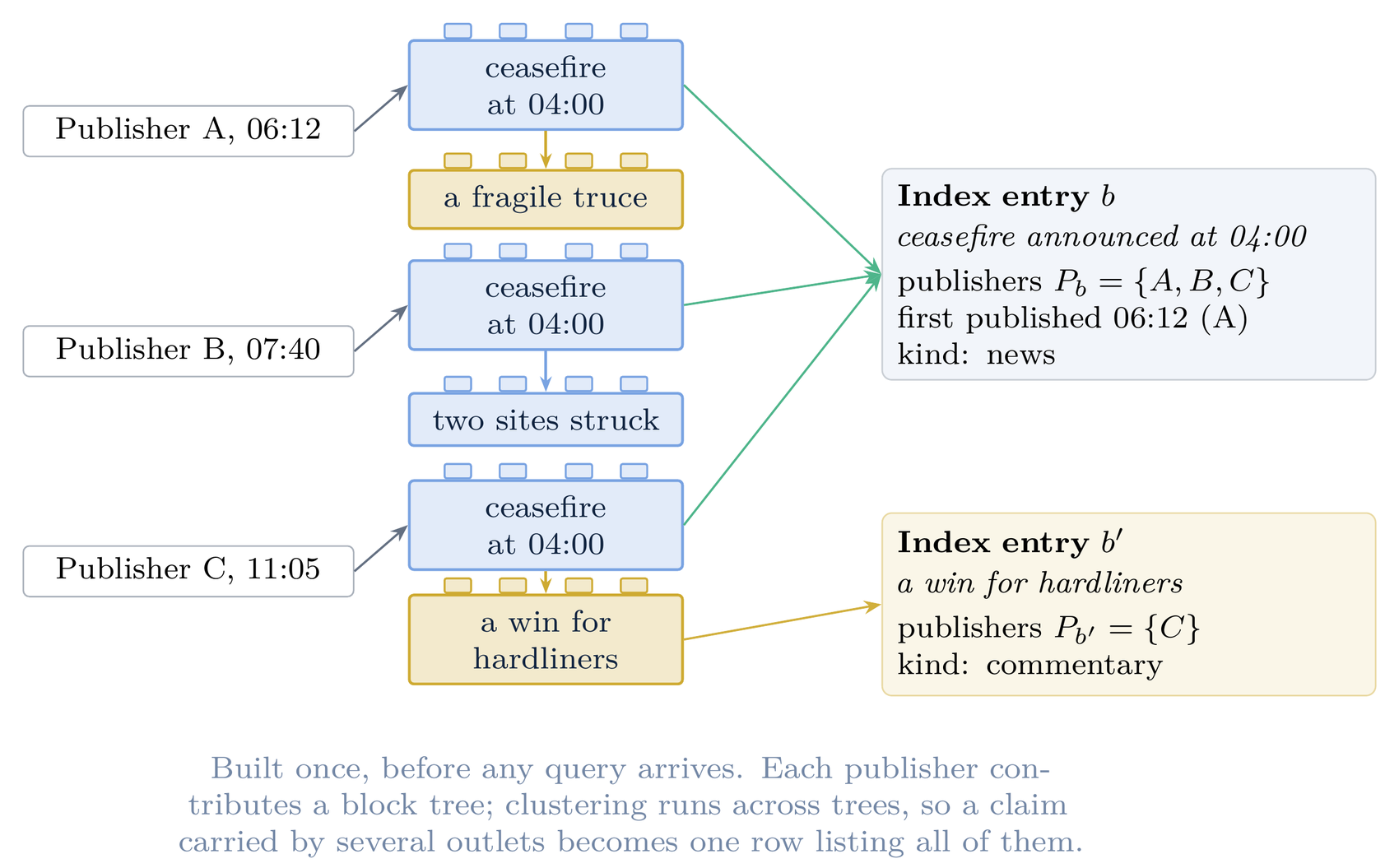
Three outlets, each with the time its article came out.
Each article is broken into pieces. All three carry the same fact: a ceasefire at 04:00.
The three copies become one row. It lists all three outlets and the first one: A, at 06:12.
A comment that only C wrote gets a row of its own, with one outlet.
In the paper's example, three outlets reported the same ceasefire, and A published first. Figure 2 Suppose an answer uses that fact. Should all three outlets share the money, or should A get it all? The paper finds that this choice matters only when you can see every outlet that carried the fact. §5.2.3 §6
The answer, in short
- Three common payment rules all come from one model of a reader, with two settings. §4.2
- Paying the first outlet moves 5 to 8 points of the money toward large newsrooms. §5.2.2
- Seen only through the articles retrieved for one question, almost every piece looks unique. Then every rule pays about the same. §5.2.3
Why does the paper count single facts and comments, and not whole articles?
An AI answer uses facts and comments taken out of articles. A market that counts articles would measure something readers no longer consume. §1
chapter 2
What you need first
How an AI search answer is made
A search engine retrieves a handful of articles for a question, the grounding set. A language model reads them and writes an answer with citations. §3.4
The Shapley value
Think of a team that wins a prize. Line the players up in a random order. Each player joins in turn and is credited with what the team gains when they join. Average that over all orders. This standard rule from game theory is the Shapley value. §4.5
Why the Shapley value is a common choice
It is the only rule with four properties together. The credits add up to the whole prize. Two players who always add the same get the same. A player who never adds anything gets nothing. Credits for two games add up. §4.5
The outlets the paper tracks
The paper's main number is the share of the money that goes to premium publishers. These are established outlets that pay reporters to gather news. §5.1.1 The list has 137 of the 1,375 outlets. It was made by hand, before any payment rule was computed. §5.1 §5.1.1
Under the Shapley value, why does a player who adds nothing get nothing?
A player is credited with what the team gains when they join. If they never add anything, every one of those gains is zero. §4.5
Why does the paper track the share that goes to premium publishers?
They are the outlets that pay reporters to gather news. A market for news is meant to fund that work. §5.1.1
chapter 3
What the paper does
A table of pieces, built before any question
A language model splits each crawled article into pieces. A news block records an event. A commentary block records an opinion, a reaction or context about an event. §3.1 The pieces form a block tree, with each comment hung under its event. §3.1
Then the same piece from different outlets is merged into one row. The result is the global index: every piece, every outlet that carried it, and when each one published. §3.2
The system: built once, then used for every question §3
Each article is split into a block tree as soon as the crawler finds it. §3.1
Pieces that say the same thing are merged across outlets into one row of the global index. §3.2
A question comes in. The search engine picks the articles, and the model answers from their pieces and cites them. §3.4
Paying is a lookup. The index already knows who carried each cited piece, even outlets the search engine did not pick. §3.4
The paper calls this index-time attribution: who carried what is worked out once, before any question exists. C.2
Figure 1: one article as a tree
Figure 1 from the paper: one article as a block tree Figure 1 open full size
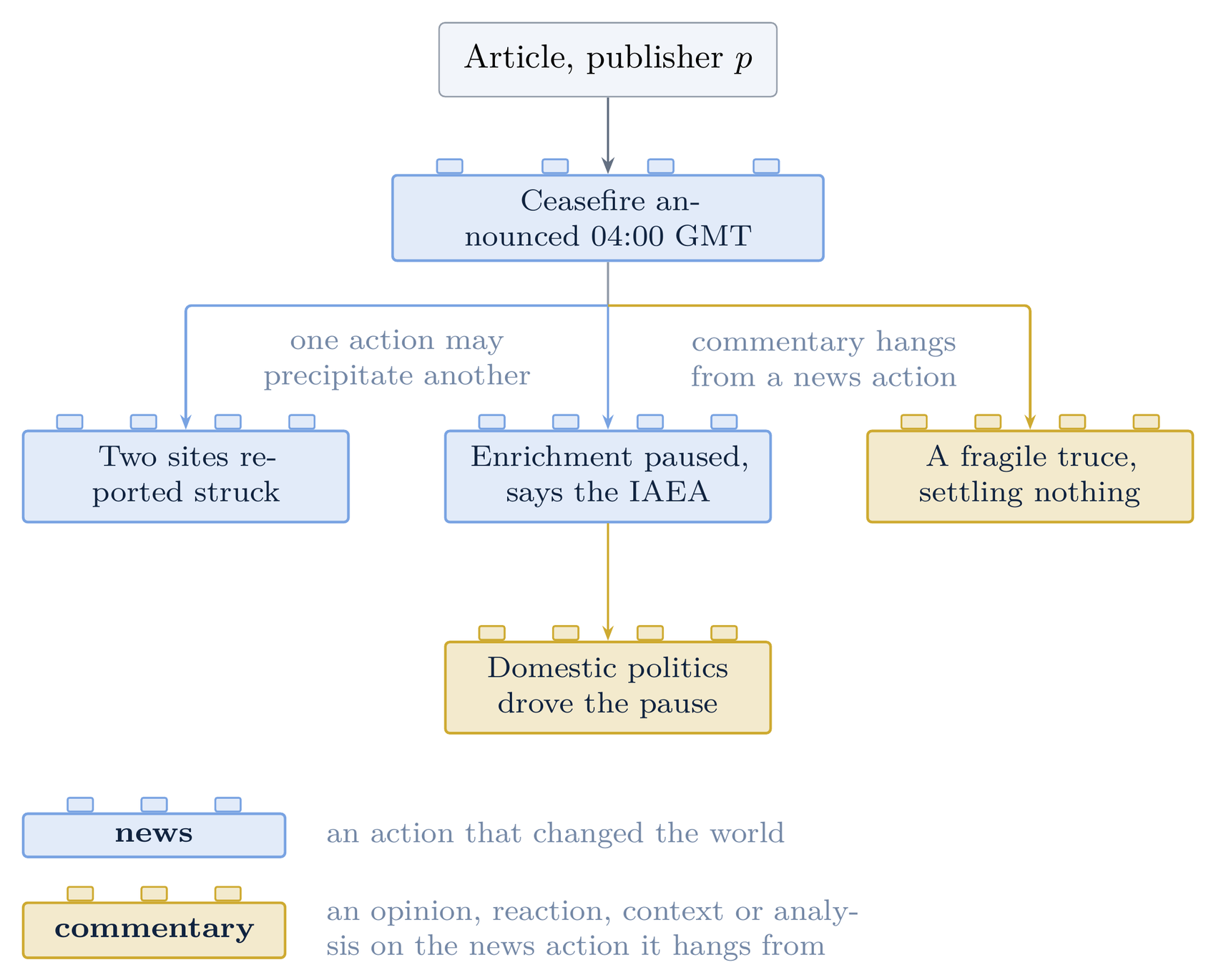
The root is a news block: the ceasefire.
Events that followed from it hang below it, as more news blocks.
Each commentary block hangs under the event it talks about.
The tree matters for merging. A comment such as "This decision was a mistake" cannot be matched alone, because two outlets may say it about different events. So a comment is compared together with the event above it. §3.2
The index records that an outlet published a claim. It does not record whether the claim is true. §3.3 Answering from pieces also saves cost. The model reads each shared fact once, so prompts used 54.4% fewer tokens than raw article text. §5.2
Three payment rules
A payment rule splits the money for each piece an answer cites. The paper studies three. §4.1
- Equal: each piece is split evenly among all the outlets that carried it. §4.1
- Provenance: each piece goes to the outlet that published it first. §4.1
- Completer: an outlet is paid for being needed to finish the answer, which mostly means holding pieces nobody else has. §4.1
Three rules, one answer §4.1
A made-up example built on Figure 2. The answer uses the ceasefire fact and the comment that only C wrote. It pays one unit in total.
Each piece is worth 1/2. The fact is split three ways, and C also gets the whole comment.
The fact goes to A, who was first. B gets nothing.
C alone can supply both pieces, so A and B are never needed.
Why the paper does not back Completer
One reader, two settings
This is the hardest idea on the page. The paper imagines a reader who reads the outlets one at a time. She gains only from pieces she has not seen yet. Each outlet is paid for what it added when she reached it. §4.2 The paper calls this the reading model.
The model has two settings. The order dial sets the order she reads in: random, or the order the outlets published. §1 The utility dial sets how much a half-finished answer is worth to her. §1
Figure 4 from the paper: two settings, four rules Figure 4 open full size
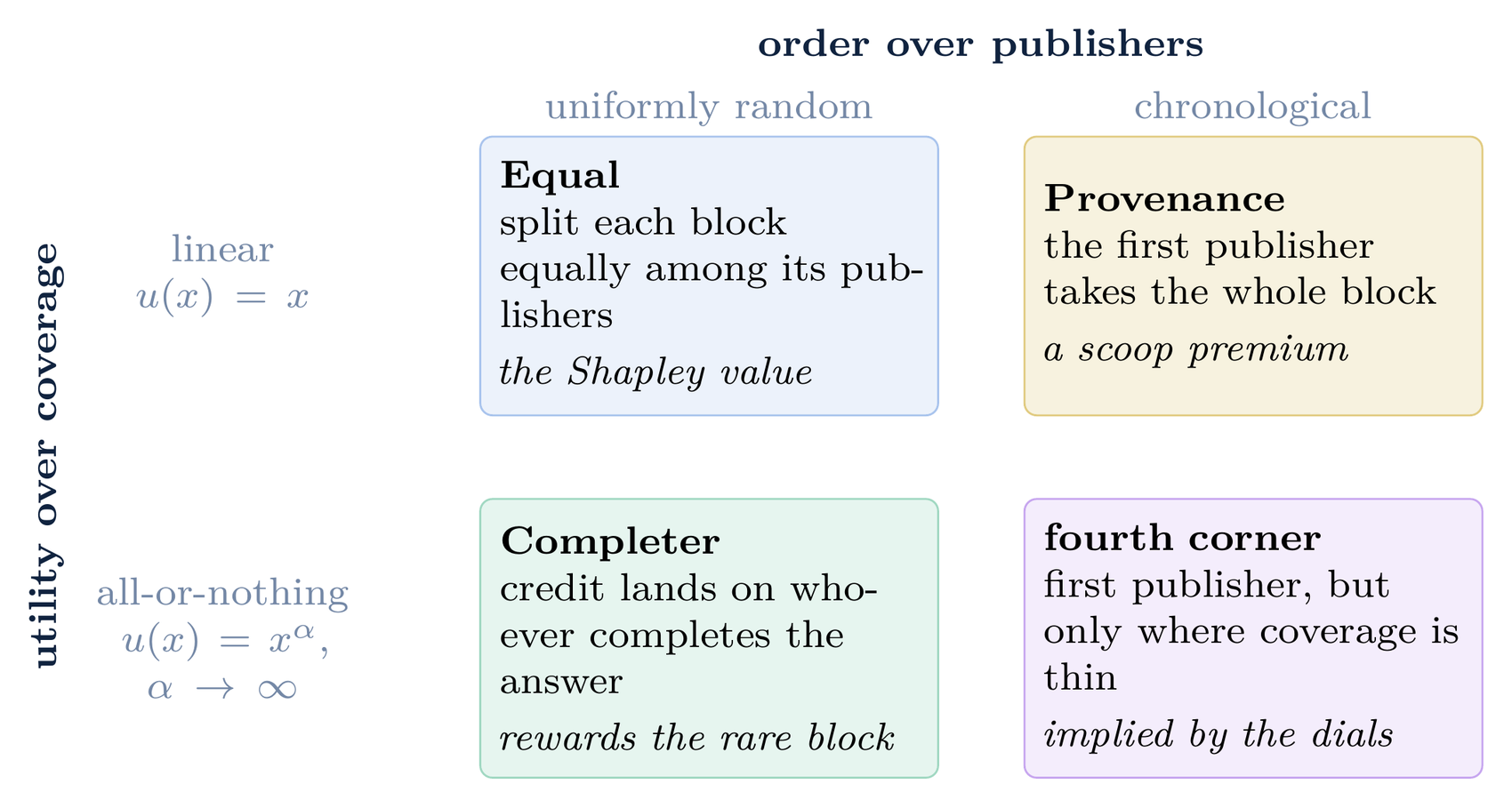
Across the top: the order dial.
Random order, and every new piece is worth the same: Equal.
Same reader, but in publishing order: the first outlet always brings the piece. That is Provenance.
Down the side: the utility dial. When only a complete answer has value, random order gives Completer.
Each rule is one setting of the two dials, so choosing a rule means choosing what the market values. §4.3 §4.4 Random order says that having a fact is what counts. Publishing order says that being first is what counts. §4.3
The formula, and each rule as a Shapley value
The reader's value for knowing a share x of the answer's pieces is u(x) = x^α, with α of at least 1. §4.2 At α = 1, every piece is worth the same. As α grows, only a complete answer has value. §4.2
An outlet's payment is the gain in u when the reader reaches it, averaged over reading orders. §4.2 With random order and α = 1, a piece goes to whichever of its outlets she meets first. Each outlet has the same chance of being met first, which gives Equal. §4.3 In publishing order, the first outlet is always met first, which is Provenance. §4.3 With random order and α growing without limit, the payment tends to Completer. §4.4
The paper also shows that Equal and Provenance are each a Shapley value of their own game. §4.5 The fourth combination, publishing order and a complete answer only, gives a rule the paper calls the fourth corner. It pays the last outlet, in time order, that the answer could not do without. §4.4
The data
The data are 1,994 search questions about the Iran/US war, asked within one hour on June 28,
- §5.1 The paper compares two ways to list who carried a piece. The global index lists every outlet in the crawl. The local index lists only outlets in that question's grounding set. C.1 Credit worked out from the retrieved articles alone, the inference-time attribution, can only see the local index. C.2
Why can Provenance not be run from the retrieved articles alone?
It needs to know who published each fact first. That depends on every outlet that carried the fact, and most of them were not retrieved. C.4
In the reading model, what changes between Equal and Provenance?
Only the reading order. Random order spreads each piece over its outlets. Publishing order gives it to the first one. §4.3
chapter 4
What they found
The same fact is carried by many outlets
In the global index, a cited piece is carried by 22.4 outlets on average. §5.2 Only 27.2% of cited pieces have a single outlet. §5.2 Facts are copied more than comments. §5.2
Paying the first outlet moves money to large newsrooms
Under Equal, premium publishers get 41.87% of the money. How many points more do you think they get under Provenance?
The part below opens after your guess.
Under Provenance, premium publishers get between 46.33% and 49.55%. The range comes from four ways of filling in missing publication times. Table 1 Paying the first outlet moves five to eight points of the money toward large newsrooms. §5.2.2 The paper's reason: large newsrooms are more often the ones that report a fact first and are then copied. §5.2.2
Inside the local index, the rules agree
In the local index, how far apart do you think the three rules' shares for premium publishers are?
The part below opens after your guess.
Figure 8 from the paper: the global index against the local index Figure 8 open full size
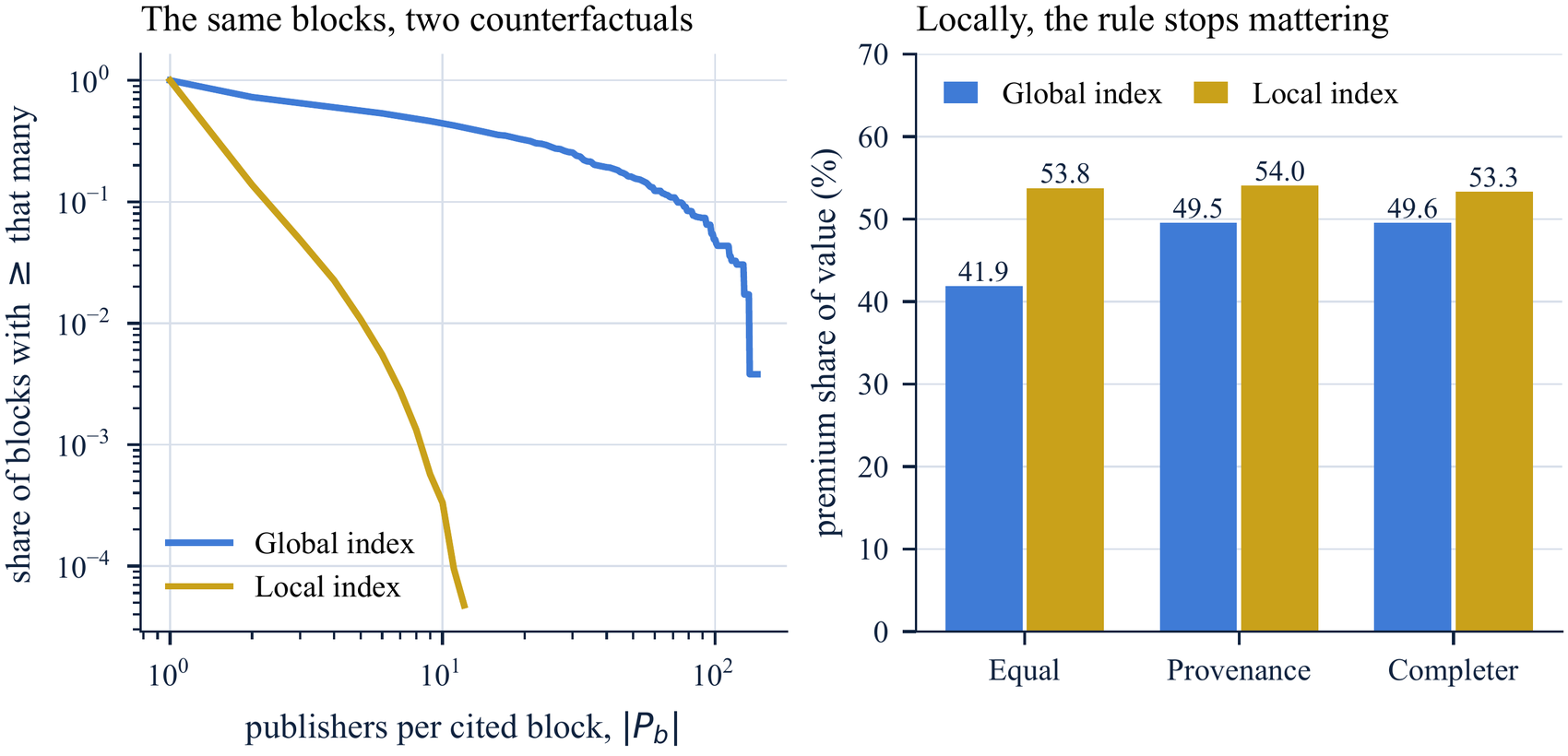
Left: for each cited piece, how many outlets carry it. In the global index (blue) many pieces have dozens. In the local index (gold) few have more than one.
Right, blue: in the global index, Equal gives premium publishers 41.9% of the money and Provenance gives 49.5%.
Gold: in the local index, all three rules give between 53.3% and 54.0%.
In the local index, 86.2% of cited pieces have one outlet, so every rule pays about the same. Table 2 §5.2.3 The rules separate only when you can see the copies, and only the global index shows them. §1 §5.2.3
This is the paper's main argument for index-time attribution. An inference-time attribution method cannot tell a fact one outlet had from a fact twenty outlets had. C.4
Equal pays more for opinion than for reporting
Under Equal, do premium publishers get a larger share of the value of news pieces or of comment pieces?
The part below opens after your guess.
Figure 7 from the paper: facts are copied more than comments Figure 7 open full size
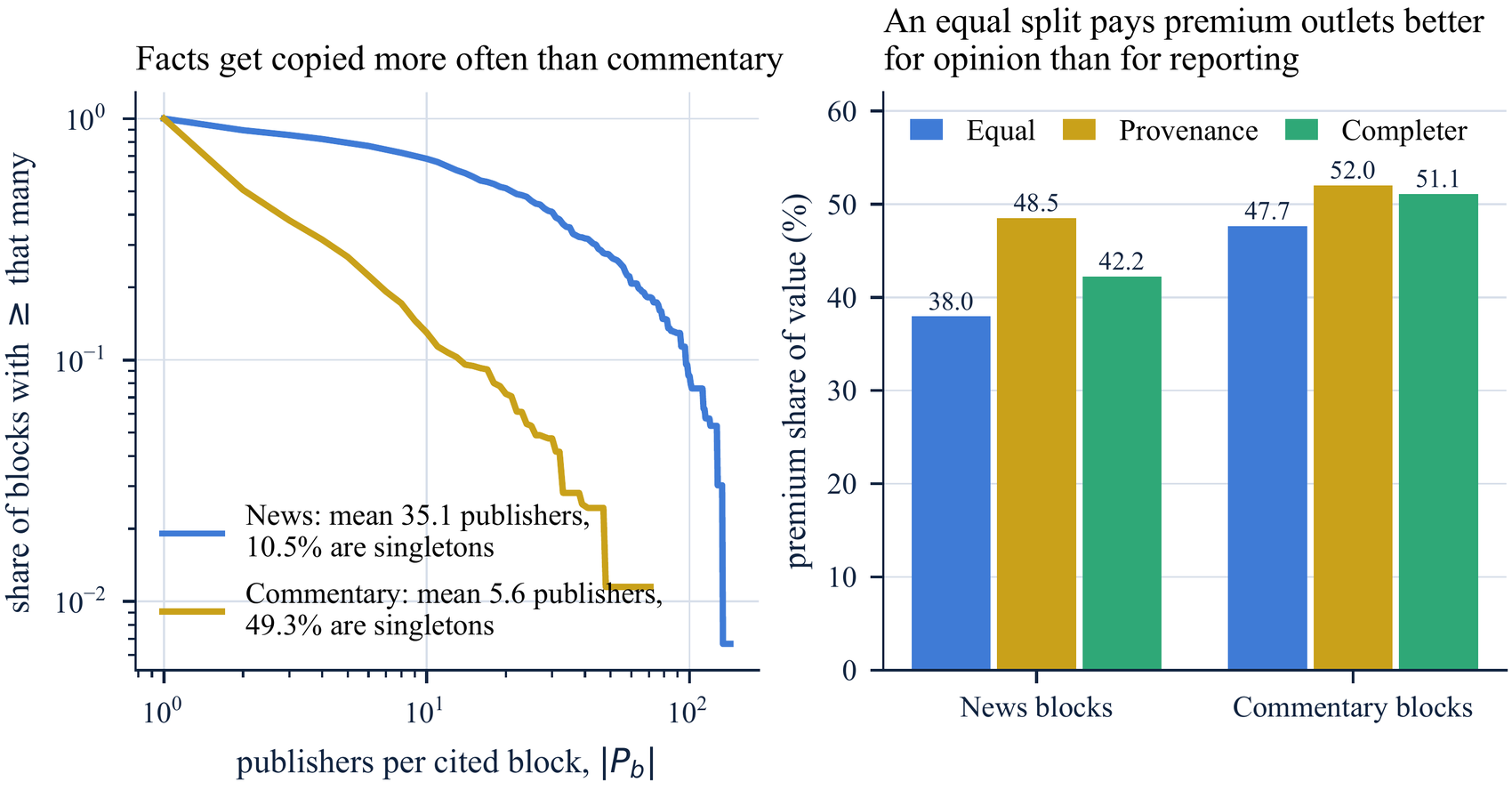
Left: blue lines are news blocks, gold are commentary blocks. News pieces are carried by far more outlets.
Right: under Equal, premium publishers get 38.0% of the value of news pieces but 47.7% of the value of comment pieces.
Under Provenance, their share of the news value rises to 48.5%.
Under Equal, premium publishers get 37.95% of the value of news pieces and 47.66% of comment pieces. Table 4 A fact that many outlets copy is split many ways, while a comment usually is not. §5.2.6 So the thing that makes reporting valuable, that others copy it, is what shrinks its pay. §5.2.6
Who is paid nothing, single outlets, and a warning about timestamps
Under Provenance, 34.6% of the outlets that carried a cited piece are paid nothing. Under Equal, every one of them is paid something. §5.2.7 The paper notes that these outlets would have little reason to join the market. §5.2.7
The Gini coefficient rises from 0.748 under Equal to 0.885 under Provenance. Table 5 Completer concentrates for another reason. An outlet that alone carries a cited piece is a veto player. These outlets take 66.3% of the Completer money. §5.2.7
The paper's Table 6 shows single outlets, with names hidden. One large newsroom ranks 29th under Equal, with 0.62% of the money. Under Provenance it ranks 3rd, with 4.70%. §5.2.8 Its facts are copied by many outlets, so Equal divides each one about twenty ways. §5.2.8
A small single-purpose site goes from 95th to 4th. §5.2.8 The authors do not believe it was first with these facts. They think its publication times sort early. §5.2.8 A first-publisher rule is only as good as the timestamps it uses. §5.2.8
Timestamps are often missing. Only 33.3% of large newsrooms' articles had an exact time, against 58.4% for the rest. §5.1.2 That gap works against large newsrooms under Provenance. §5.1.2
The utility dial, and Completer against Provenance
Figure 9 from the paper: turning the utility dial Figure 9 open full size
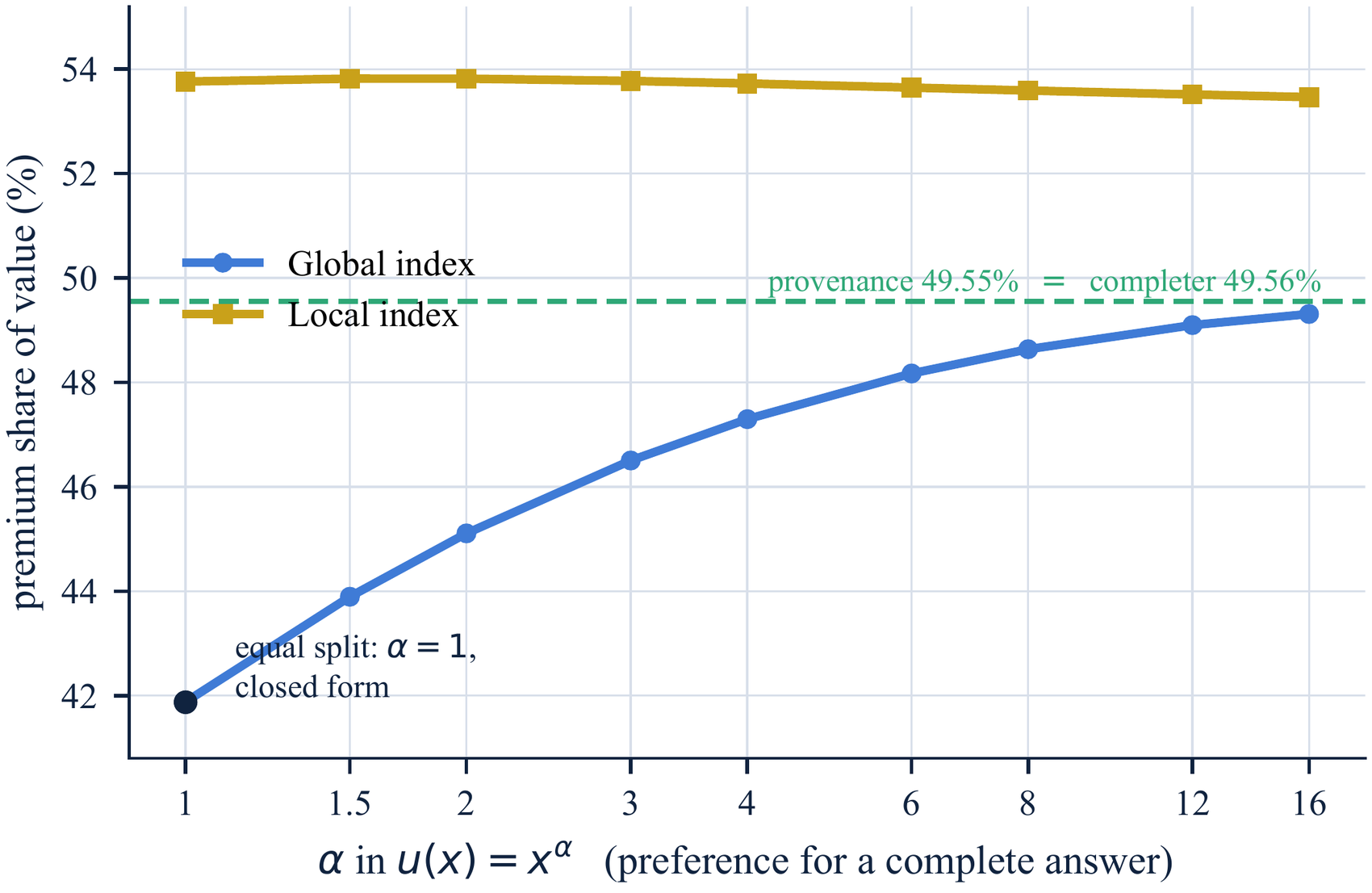
At α = 1 the reader values every piece the same, and the rule is Equal: 41.87%.
As α grows, a complete answer matters more, and the premium publisher share rises. Most of the rise comes early.
The limit is Completer, at 49.56%, next to Provenance at 49.55%.
In the local index, the dial changes almost nothing.
Completer and Provenance give large newsrooms almost the same total: 49.56% and 49.55%. §5.2.4 They do not pay the same outlets. The total variation between their payouts is 33.7 percentage points. That is larger than the distance from either one to Equal. §5.2.4
The paper also splits large newsrooms by country. All of the gain from Provenance goes to American outlets, from 20.09% to 28.70%. International ones fall slightly, from 21.79% to 20.85%. B.1 The crawl came from a US-facing product, which the paper says may explain part of this. B.1
The result survives a wrong index
A language model builds the index, so some rows are wrong. The paper has no hand-checked answer key to count them. So it asks how much error the result could absorb. B.2
It adds three kinds of error to the real index on purpose, at rates up to one record in five. B.2
The result on a wrong index Table 8
The real index: a gap of 7.68 points.
Two errors make rows hold fewer outlets. The gap barely moves.
Merging adds outlets to a row. It widens the gap a little.
The gap between Provenance and Equal stays between 7.62 and 8.12 points. Without added error it is 7.68. B.2 Splitting and misfiling shrink every outlet's rows by the same share, and neither rule changes when that happens. B.2
The test cannot catch errors that hit one kind of outlet more than another, such as worse parsing of wire copy. Measuring that would need labeled ground truth, which the authors do not have. B.2
Why does Equal pay premium publishers less for news than for comments?
News facts are copied by many outlets, so each fact's value is split many ways. Comments are copied less, so they are split less. §5.2.6
Why does making one record in five wrong barely change the gap between the rules?
Splitting and misfiling shrink every outlet's rows by the same share, and neither rule changes when that happens. Only merging moves the gap, and only a little. B.2
chapter 5
What this does not show
The paper states these limits itself. §5.3
- One news story, one system. §5.3
- First to publish is not first to find out. The data cannot tell independent reporting from copying. So Provenance pays for being early, which may or may not mean doing the work. §5.3
- Bounded by the crawl. The global index holds what was crawled. A larger crawl could only widen the gap between rules, so the paper reads its gaps as lower bounds. §5.3
- Not measured. Answer quality, prices and how outlets would respond. §5.3
More limits, and the costs of the index
Many publication times are only dates, and the paper fills them in. Its four ways of doing so agree here, but may not on other data. §5.3 Payments are also computed only over pieces that answers cited, so they still depend on what the search engine retrieved. §5.3
The index inherits the language model's errors. It must be kept up to date, and new articles count only once indexed. C.5 The paper suggests the two kinds of method work together. Inference-time attribution can check that answers use what they cite, and the index can settle payments. C.5
Why does the paper say Provenance pays for being early?
Its data show who published first. They cannot show whether that outlet found the fact itself or copied it from someone faster. §5.3
Why does the paper read its gaps between rules as lower bounds?
A larger crawl can only add outlets to each piece's list. More copies make the rules differ more. §5.3
chapter 6
Questions people ask
Short answers to common questions. Each one points back to the paper.
How should AI companies pay news publishers?
The paper proposes paying for each fact or comment an answer uses. §1 It compares three payment rules. The choice moves 5 to 8 points of the money between groups of outlets. §5.2.2
What is a publisher content marketplace?
It is a market where an AI company pays publishers for information its answers use. Abstract The paper's version counts single facts and comments. It keeps a shared index of who reported each one, and when. §1
What is a Shapley value?
It is a way to split credit in a team. Line the players up in random orders, credit each one with what it adds when it joins, and average. §4.5 In this paper, all three payment rules can be written as Shapley values. §4.5
Why do fewer people click news links in AI search?
The answer already tells them the news. A study the paper cites found click-through on 8% of searches with an AI summary, against 15% without. §1 Users clicked a link inside the summary on only 1%. §1
Can you tell which source an AI answer used?
Methods that look at the retrieved articles can tell which ones moved the answer. C.2 The paper argues they cannot see other outlets that reported the same fact, which matters for payment. C.4
keep it
This page has 10 check-yourself questions. The review page asks them again after 1, 3, 7 and 21 days, one at a time. You can also download them for Anki.
chapter 7
Words to know
Hover or tap any underlined word on the page to see its entry. These are the terms this page uses, in the order it introduces them.
- publisher content marketplace (market that pays publishers)
- A system where an AI company pays news publishers for the information its answers use."We propose a publisher content marketplace that allocates payments for information used in AI-generated answers." (Abstract)
- lego block (single piece of content)
- One fact or one comment, written as a short sentence. Many outlets can carry the same one."The unit of attribution is a “lego block”: a distinct fact or piece of commentary that may appear in articles from multiple publishers." (Abstract)
- grounding set (retrieved articles)
- The handful of articles a search engine pulls up for one question, which the model reads before it answers."When a query arrives, a search engine retrieves a grounding set of relevant articles." (§3.4)
- Shapley value (average added value)
- A way to split credit in a team: line the players up in every order, see how much each one adds when they join, and average."The Shapley value of a cooperative game assigns credit to individuals by considering their marginal contribution to the characteristic function over a uniformly-random subset of players." (§4.5)
- premium publisher (large newsroom)
- An established outlet that pays reporters to gather news, such as a national newspaper, a wire service or a broadcaster. The paper's list was made by hand."This is a designation intended to capture established outlets with substantial original newsgathering operations, in contrast to aggregators, syndicators, and low-cost republishers." (§5.1.1)
- news block (fact piece)
- A piece that records something that happened: who did what, when and where."News blocks record an action: a verifiable state change in the world brought about by individuals, organizations, or nature (e.g., a vote, a strike, an attack, or a hurricane)." (§3.1)
- commentary block (comment piece)
- A piece that records an opinion, a reaction or some context about a news event."Commentary blocks record an opinion or reaction (typically through a quote for non-opinion pieces), piece of context, or analytical stance about a news action." (§3.1)
- block tree (tree of pieces)
- One article broken into pieces, with each comment hung under the event it is about."Our index decomposes the text of each article in a corpus into a tree of atomic blocks." (§3.1)
- global index (index of every crawled article)
- One table of every piece found in all crawled articles, with every outlet that carried each piece and when."P_b is every publisher in the index who carried block b, whether or not their article was retrieved for this query." (App. C.1)
- index-time attribution (credit worked out when articles are stored)
- Who carried each piece, and when, is recorded once, when an article is crawled. Paying for an answer is then a lookup."Index-time attribution, which our system employs, calculates attribution as part of the indexing work that occurs before any query exists." (App. C.2)
- Equal (equal-split rule)
- A payment rule: every outlet that carried a piece gets the same share of that piece's value."Each block is worth 1/n and is split evenly among its publishers" (§4.1)
- Provenance (first-publisher rule)
- A payment rule: the outlet that published a piece first gets all of that piece's value."Each block's value goes entirely to whoever published it first, with ties split evenly" (§4.1)
- Completer (can't-do-without rule)
- A payment rule: an outlet is paid for being needed to finish the whole answer, which mostly means holding pieces nobody else has."Each publisher is, loosely speaking, credited for the unique blocks it contributes." (§4.1)
- reading model
- A made-up reader who reads the outlets one by one and only gains from pieces she has not seen yet. Each outlet is paid for what it added."Consider a stylized reader—think of her as the buyer's proxy—who is handed the grounded sources for a query and works through them in some order π." (§4.2)
- order dial (reading-order setting)
- The setting that chooses the order the reader reads the outlets in: random, or the order they published."the order dial (whether speed deserves reward)" (§1)
- utility dial (completeness setting)
- The setting that says how much a half-finished answer is worth to the reader."the utility dial (how heavily completeness is valued)" (§1)
- fourth corner (last-needed-outlet rule)
- A payment rule the framework produces but nobody proposed: pay the last outlet, in time order, that the answer could not do without."The fourth rule, chronological order with an all-or-nothing buyer, pays the publisher whose arrival completes the answer, where arrivals are ordered by publication time." (§4.4)
- local index (index of the retrieved articles)
- The same kind of table, but built only from the few articles the search engine pulled up for one question."P_b is every publisher who carried block b in the query's grounding set—the handful of articles the retriever actually surfaced." (App. C.1)
- inference-time attribution (credit worked out per answer)
- Credit is worked out after each question, from the few articles retrieved for it."Inference-time attribution waits for a query and, while generating an answer, works out which of the retrieved documents caused which parts of the generated responses." (App. C.2)
- Gini coefficient (inequality score)
- A number from 0 to 1 for how unequal a split is: 0 means everyone gets the same, 1 means one outlet gets everything."We use the Gini coefficient to measure concentration of payments" (§5.2.7)
- veto player (sole supplier)
- An outlet that is the only one carrying some piece the answer used. Without it the answer cannot be complete."a publisher that uniquely supplies some cited block is a veto player" (§5.2.7)
- total variation (payout difference)
- How much of the money would have to move between outlets to turn one rule's payouts into the other's."Distances are total variation between normalized publisher payout vectors, computed over all publishers" (Table 3)